Sunday, 21 October 2012

Life Since... February

Hello everyone!

Well, it maybe the time I close my blog as I'm sure you've noticed I haven't updated it since February! I've been doing some exciting things and played a bit of chess as well, so you might be interested to know what I've been up to before I say the final good bye.

I spent a few months teaching chess to kids in a primary school, as a part of the Chess in Schools and Communities charity scheme. It was a new experience for me and I'm glad that most of those 70 or so kids now know how to play chess and more importantly - enjoy it! A few of them even went to a local competition between schools and did very well. I also received some wonderful chess poems from one of the groups, so full of imagination and humour! I found it so hard to judge between them to award the best.

A few weeks back I also did reporting for the Russian website chess-news.ru from the recent Grand Prix held in London. I took lots of photos and did interviews with many of the participants, mainly in Russian. I found it particularly amusing that I managed to get an exclusive interview from the winner, Veselin Topalov, at the end of the tournament. He shared the first place with Shakhriyar Mamedyarov and Boris Gelfand, but had a better tie-break. I don't think Veselin did an interview for the official site at the end of the tournament, but I managed to get one!


What can I say, I had such a great time there - I met some new interesting people; that includes the organisers, the super-GMs who were playing and many others who were there either to support the players, provide media coverage or just visit. Of course, I also saw many people who I already know from chess and it was nice to catch up with old friends. I can report that most of of the super-GMs present were quite easy to talk to, seemed like nice people and have a good sense of humour :) But, one thing I realised was that despite playing chess for so many years, I still had no idea what super-GM's life is like. It's incredibly intense and believe me, despite an appearance of so many draws, they ALL want to win each and every game! I honestly promise you that! I absolutely didn't notice the attitude of, "I'll just take it easy today". I was also glad that Boris Gelfand got a share of the first place, as he got some really unfair criticism during his match against Vishy Anand. He actually has a very exciting playing style and it shows when he gets his kind of positions.

So, back to me then! I played in an Open tournament in Crete in July. The place was wonderful - sea, hot sun and great food - but I didn't play very well. I did, however, get selected to the England women's team to play in the chess Olympiad that was held in Istanbul in September. I was even put on the second board, which was a bit tough, as you can imagine! Well, it was a great experience anyway. Here, on the photo, I'm actually on the top board, as our board one, Anya Corke, was resting on that day. We won against Quatar 4:0 anyway. Apart from me on that day we had Sarah Hegarty, Sabrina Chevannes and Kanwal Bhatia playing, as you can see. At the end of the tournament we ended up at around our initial seeding, while Sarah performed particularly well. I must also say big thanks to our coach GM Stephen Gordon, who was wonderful.

 
I didn't get to see much of Istanbul because we lived near the airport, about an hour from the city centre. But I did go to a couple of historical sites on my free days and was especially impressed by the bazaar. It was so colourful! And the Turkish delight was delicious! All that remains to say about the Olympiad is congratulations to the winners - the Armenian men's team and the Russian women's team! And I hope that English and Russian men can do a bit better next time!

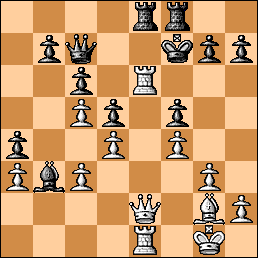
I'll leave you with some chess tactics from my game in the women's Wales - England match, used as a preparation for the Olympiad. I was trying to figure out how to win for a while, probing here and there. And finally I was rewarded when my opponent fell into a rather simple trap. Her last move was
50.Rec2??

L. Roberts (1933) - M. Yurenok (2084)
Wales - England Match, 19 May 2012


50...Rxb2 suddenly, the rook on c2 is overloaded. It's no good taking my queen 51.Qxd4 as it's checkmate with Rb1# So, she played:
51.Rxb2 Qxc3 it's winning for me now, of course, but she made it even worse for herself with:
52.Na2? Rxb2 53.Qxb2 Qxd3 and I won a few moves later.
Incidentally, England won that match 4:0, although we were a little lucky in some cases.

And that's all from me! My life goes on, although perhaps not with as much chess playing as before. I will continue to play at the 4NCL and, if things work out in my favour, will play at the London Chess Classic Open in December.

Till we meet again! До новых встреч!

This blog is now closed.

Monday, 13 February 2012

Aeroflot Open Interviews

Hi all,

Aeroflot Open is currently in progress in Moscow and I've seen some amusing interviews in Russian published on the Russian Chess Federation website. Here is my translation of selected material. You can see the photos in the original version.

First of all, an interview with GM Anton Korobov (rating 2660) who is currently leading Aeroflot Open Group A with 5 out of 6. The interviewer mentions that Anton doesn't give any serious answers but rather jokes all the time and gives rather original answers.

Tell us a bit about yourself.

I was born in the Soviet Union in 1985. I started playing chess spontaneously. My friend in the kindergarten said that his dad knows many "mates". I asked my parents what he was on about and they said that his dad is probably a strong chess player. I was very interested in this and it started from there. Now I work on chess myself and analyse some slowly progressing challenges with others.

Have you been invited into the national team [Ukraine]?

No, it looks like I'll never play in it.

Why are you so pessimistic?

I'm too old. They only take young, early developing and politically proficient people - quoting Ostap Bender [famous fictional figure in the Soviet satirical literature].

What are your most serious chess achievements?

I don't have any serious achievements, only unimportant ones. The biggest one is 3467 rating on the ICC. Second place in the Aeroflot Open 2010 was a fluke.

How about your win against GM Maxim Rodshtein today?

It was a usual situation. I didn't know the opening, couldn't figure out the middlegame and was waiting for an unpleasant endgame, but my opponent lost on time.

Do you have any chess idols?

They change from time to time. I had Fritz 8, then Rybka 1.2, Rybka 2.2, Rybka 3. Deep Rybka 4 and then Houdini 1.5. Now it's Houdini 2.0. Perhaps, I'll have a new idol this year.
____________________________________

The next interview is with GM Francisco Vallejo.

Francisco, how is it going?

The tournament is very strong. I like it very much because playing in such a tournament helps to improve my game. But I'm playing terribly. It started in the game with GM Gupta. I had a familiar position but got confused right at the start, so the game ended in a draw. In the next game with GM Sokolov I had several winning continuations but I managed to lose. And the same thing happened yesterday. Today I drew in an almost winning position. I want to go home!

Do you prefer playing in opens like this or in super tournaments like Linares?

It's better in super tournaments because if I'm playing badly then I have an excuse because the opponents are very strong. Here it looks like the opponents are not stronger than me but I'm playing badly anyway. I'm not disappointed about the result as much as about the quality of my games. It's as if I was a journalist and made mistakes in basic words.

Ok, in this case enough about chess! How is life in Spain in the current economical crisis?

Crisis is very serious in Spain. It affects the tournaments as well. Linares has big problems with finding a sponsor. I'm lucky as I work in other countries. I play in Germany, for example.

So you don't feel vulnerable in this situation?

I do in some sense. For example, by brother lost his job. There are more than 5 million unemployed in Spain. It's more than 20% of the population. It affects my friends and my family. But I'm an optimist. I always try to think how lucky I am in life. I'm healthy, can play chess and work. Recently I saw a documentary about the life of penguins. I wouldn't have liked to be one of them! They live in temperatures of -50 Celsius and for some time without food. They have to protect each other by standing in a circle keeping the warmth. When I remember this I can say that really I'm a happy man!
_______________________________________

And finally, an interview with GM Fabiano Caruana who showed some amazing results recently and progressed into the chess elite. It has already been translated into English by Chessbase so please follow the link.

Friday, 10 February 2012

Gibraltar Tournament

Unless you've been living on the Moon for the past couple of weeks, you know that GM Hou Yifan had a fantastic tournament in Gibraltar, gaining shared 1st place with the British GM Nigel Short and beating several GMs over 2700! This was one of the best ever women's performances even compared to the legendary GM Judit Polgar. Yifan is still only 17 years old and I will continue to follow her chess career with great interest. This is what I call girl power!


The tournament turned out quite disappointing for me with 4 out of 10 as I lost a lot of rating. For some reason my brain deserted me in the first three rounds as I was struggling to achieve my usual level of concentration. I knew I wasn't playing well without even looking at the results. There were a lot of blunders and I kept thinking for even longer than I normally do during the games. I just didn't know how to get myself into the necessary chess mood. I think this happens to a lot of chess players - you know something is not quite right with you but you're not quite sure what's causing it so as to address it quickly. I did better after round 3 and performed at around my rating but still was far from happy about the quality of my games. I guess the only happy moment happened when I managed to save a long and lost endgame against 2300-level player. My games continued to be quite long, averaging at about 57 moves - probably not good for my energy levels! Simon suggested that I change my openings so I win quicker! I actually don't mind playing endgames, I even enjoy them. But what's become very clear now is that to improve there are two key areas I need to address as a priority. I need to learn to play endgames much better (even though for my rating level I'm quite good at it) and I must improve my calculation skills. It was especially interesting to hear from GM Judit Polgar in her recent interview that she spent a lot of time on endgames and tactics in her early years while she didn't think that studying openings was that important for players up to 2500. And look at GM Magnus Carlsen - he's probably the best endgame player in the world. So I think endgames are really "in" at the moment. Anyhow, here is a nice photo of me from the now famous chess photographer Ray Morris-Hill.


On a positive note, ECF has released half-year ratings for the first time and I have the highest ever rating of 189. At least something is moving in the right direction! Also, I must mention that I found Gibraltar Masters tournament and Gibraltar itself very interesting. The tournament was great for me as a spectator since there were many famous chess players, even though I had very little time to spectate due to my own long games. The hotel was great - everything a chessplayer may need, even free Wi-Fi. My room had a view straight into the sea - it was amazing! And I did have a chance to explore Gibraltar a bit. I visited the caves, the war tunnels and, of course, the famous monkeys. I took so many photos as I was enjoying my new camera while trying to learn the settings a bit better. Here is my favourite monkey photo - isn't he just such a cool dude?


There's not much to show from my games in Gibraltar. I do have one interesting/sharp endgame in mind but I'll leave it till next week. This weekend I'm off to the 4NCL, so I hope I'll have something interesting to show from it. There are no more tournaments planned for me for the time being, but I do fancy going somewhere nice towards the summer.

A couple of people contacted me with interesting chess material. If you're interested in chess representation in paintings, I recommend this interesting YouTube link, created by Miroslav in Paris:
http://www.youtube.com/watch?v=IAn4uEi1x8I
If I understood it correctly, the art seems to progress from very old to modern day, so if you have an interest in a particular art period then I suggest scrolling the video to that point.

I was also contacted by Pablo - developer of the free "Social Chess Clock" application for Android phones. This gives you an ability to use your phone as a chess clock, even with increment. This could be handy on long and boring train journeys if you want to entertain yourself and a friend with some blitz! Unfortunately, I have an iPhone so I can't test this application. But please do let me know your feedback if you decide to use it.

With my Russian language skills I find that a lot of interesting interviews with top chess players never get translated from Russian into English. So I decided to do something about it! Look out for some interesting interviews and other chess news items translated from Russian on my website in the near future. And I leave you with the photo of GM Nigel Short - the winner of Gibraltar Masters on play-off with GM Hou Yifan. This was a great result for Nigel even though he always seems to do very well in Gibraltar.


Tuesday, 17 January 2012

January 4 NCL

I played at the 4NCL last weekend, for the first time this season. I had to miss the first weekend (two rounds) of the season due to the European Team Championship in November. I think I've already mentioned that my team has been re-named from Betsson.com to Blackthorne Russia because our new sponsor is the company called Blackthorne which specialises in exports to Russia. We even got our sponsor's t-shirts to wear, but I found out that my "small" size t-shirt was way too big for me, probably 4 sizes too big. In fact, it fitted my partner IM Simon Ansell rather perfectly, and he normally wears "medium" size t-shirts. I decided to stick with wearing my own clothes. Although it did cross my mind that I could possibly get away with wearing the t-shirt as a short dress, since it wasn't just big in the shoulders but also quite long!

So, what about the results? Simon and I did rather well, each gaining 1.5 out of 2. But our team narrowly lost both matches 3.5-4.5. This means that it would be near impossible for us to get into the championship pool after 7 rounds and instead we'd have to fight off relegation in the relegation pool. To get into the championship pool we'd probably have to win 3 remaining matches and in one of them we'd have to beat Wood Green who are currently top of our pool and very strong. In the 4th round they fielded GMs on all boards beating their main rival Guildford 1 in the process by 5.5-2.5. Here I am playing against John Sugden rated 2180 last Sunday.


Although I had a nice win on the Sunday, it was more of a technical win with a pawn up rather than something exciting to show. Instead, I'd like to show you how I managed to miss a clear win in my recent London League game when I was playing for Hackney 1 against Drunken Knights 2. I got into time trouble again! This was partly because I was trying to remember the theory in the gambit that my opponent played and partly because I was out of practice. In any case, it seems that this game served me well as I handled my clock rather well over the 4NCL weekend. White to move.

M. Yurenok (ECF 179) - G. Leyton (ECF 167)
London League, 9th January 2012


My opponent has just moved his queen from e7 to e8 which was a mistake. He should have played Bd6 instead. At this point I still had to make 9 moves to the time control while I had maybe 1 or 2 minutes left without increment. I was in desperate time trouble but managed to find the right move:

21. Rxc7! my idea was that if black plays 21...Kxc7 then I win some material with 22. Qc2+ Kb8 23. Bd6+ Ka8 24. Bxe5 +- and there are still more threats as f6 knight is pinned and hanging. It seems I didn't notice that I can actually deliver a typical checkmate in this variation with 24. Nb6+ axb6 25. Qa4# I guess this is not too important if I'm clearly winning anyway. And in any case, black didn't have to retreat with the king on the 22nd move, but could give up the same piece differently with 22...Nc6 avoiding the checkmate. So, my opponent played:

21...Bxb5 I expected this move as I mistakenly thought it was the best reply, so I pre-planned my answer worrying that my flag might fall before I can make it to 30 moves. I immediately replied with:

22. Rxb7? =/+ this gives up all of my advantage. When you're short of time, simple and obvious moves are missed. I didn't think of moving my rook the other way, now that the bishop has left d7. The correct move was 22. Re7 At this point my computer announces +8 winning advantage for white. Oh dear :( Black can respond with 22...Bxa4 attacking my queen in return, and here the simplest for white is just 23. Rxe8 Bxd1 24. Rxh8 Rxh8 25. Rxd1 emerging with a clear piece up. My game eventually ended in a draw and my team lost 5-7. Strange that we beat the stronger Drunken Knights 1 team with 9-3 score earlier in the season!

For the past couple of days I've been following some of the Tata Steel Chess live tournament games on their website and I discovered something. They have Houdini engine giving evaluation of every move made, and it seems that even grandmasters sometimes go passed +8 advantage! Ok, not super-grandmasters but still strong players. For example, look at the GM Brandenburg - IM Grover game from round 3 in group C, which ended in a draw and where each opponent had +8 advantage at some point according to Houdini! I don't feel so bad after all :) There are lots of serious mistakes in other games too which can be fun to watch, but then anyone is clever with the help of a computer. I actually prefer listening to commentary by strong players who don't use computers, like they had in the World Cup with GM Shipov for example.

Sunday, 8 January 2012

Happy New Year!

Happy New Year everyone! This year has started with a big change for me as I've left my job. No, I'm not going to become a full-time chess player, but I'd like to see what I can do outside of the corporate world. I would like my new activities to be connected to chess in some way or another, so I may explore chess teaching, chess publishing and anything else I might find interesting. If you have any ideas, suggestions or even chess-related business opportunities then please let me know! Apart from my chess and Russian skills which you already know, I have worked in small and large companies in a variety of industries, ending up in a fairly senior management position in my last job. With my wealth of experience I can safely say that I have a good understanding of all aspects of running a business.

As you can imagine, this big change in my life has kept me very busy in the past few weeks since the European Team Championship in November. Now I have some time to update you on what happened to me at that tournament. As you must already know, Germany surprisingly won the Open tournament while Russia won the Women's tournament. The Greek hotel and food were very nice, but I have to agree with comments from other chess players that the playing hall was too stuffy. It wasn't great for  keeping a clear head, especially if you have long games like me :) English women's team performed at their seeding by getting 23rd place, while our star performer was IM Dagne Ciuksyte on board 2, gaining 6 out of 8 points. It's especially amazing as she had both of her little children with her. English Open team unfortunately didn't perform as well as expected, but the Open tournament was very strong and full of surprises. However, our GM Michael Adams had a fantastic result and won gold on the top board! I got 3.5 out of 8 points on board 3 of the Women's team and performed a bit better than my rating, which I thought was fairly satisfactory for my first performance in the English team. Here is our team in the last round against Netherlands (from right to left): Jovanka, myself, Kanwal and Sarah.


The tournament was quite tiring for me as all of my games except one were over 40 moves long, with two games close to 80 moves. With this sort of pattern emerging, I think I should revise endgames! I really enjoyed my rest day in round 5, as I could observe all the top teams and grandmasters playing. I probably found that day even more tiring than playing, as I had a headache by the end of it, probably from trying to assess many positions while walking around! Of course, I support England first but continue to support Russia as a second choice, so I was delighted that Russian women won the tournament. And I was disappointed that Russian men didn't get the medals. But I found it very fascinating watching the Russia-Ukraine Open match in round 5 which Russians won. I still remember how positions unfolded in the match. Here is the match as it started, you can see the Russian men GM Svidler, GM Grischuk, GM Morozevich and GM Nepomniachtchi. On the Ukrainian side you can see GM Ivanchuk, GM Ponomariov and GM Moiseenko, while GM Efimenko is completely obscured.


Svidler-Ivanchuk was the first to finish but it was rather exciting with castling and attacks on the opposite sides ending in perpetual. To be honest, I wasn't really sure what was going on there! Then my attention switched to Ponomariov-Grischuk game as I struggled to clearly see the lower boards from behind the spectators' rope. It looked to me that Grischuk had nerves of steel because he grabbed a pawn with black while lagging in development and with uncastled king. Soon he was in his usual time trouble in what looked like a very complicated position. But what do I know? He managed to simplify into a worse endgame. And while I thought Ponomariov could have made it a bit harder for Grischuk in the endgame, I was glad it quickly ended in a draw. After the end of that game I could see the games on the lower boards much better, especially since it was easier to make out the few remaining pieces in their endgames. It looked like Morozevich had a winning endgame but I think I would have found it tricky to convert. Of course, no such problem for Morozevich. And Nepomniachtchi looked in a lot of trouble with an exchange down. I really thought he was gong to lose even though I wasn't quite sure how to win if I was his opponent. It just looked like there must be a way and Efimenko would figure it out. However, Nepomniachtchi kept very active with his pieces and pawns. This posed technical problems to Efimenko who eventually started running out of time and had to agree to a draw.

Unfortunately, my photos of the English Open and the Russian Women's teams didn't come out as well. I have just bought a new and much better camera, so I will hopefully be taking some great photos in the future. I had some interesting games which I'd like to share with you. It was the case of missed opportunities against three players over 2300. First of all, in round one I was close to winning but squandered my advantage in the time trouble. Here is the critical moment in the game, white to move:

M. Yurenok (2106) - E. Djingarova (2309)
The European Team Championship - Women, 3rd November 2011


Right here I had to make one more move before the time control. Of course, I saw 40. Rc6 and thought it looked like the right and active move to make. But with few seconds left on the clock I decided to go for the safe option and defended my pawn with:

40. Bf3? Rb3+ 41. Ke2 Rb2+ and here I couldn't see how to make progress so I agreed to a draw after two more repeated moves.

Instead, 40. Rc6! is winning, for example:

40...Nxd5+ 41. Kf3! (it's important not to play 41. Kf2 to avoid the pin, I think this is partly what I missed when looking at this line during the game) 41...Rxb4 42. Rxd6+ Nf6 43. Bd3 Kf7 44. Rxb6 Ne4 and here even simple 45. Bxe4 +-  wins. You can see why I was annoyed with myself!

In the next game I was defending for a long time and eventually got to this peculiar and complex endgame, white to move.

M. Yurenok (2106) - M. Ohme (2361)
European Team Championship - Women, 6th November 2011


Here I was going to play 54. Rg4 so as to start pushing my pawns forward. Ok, it looked a bit tricky with black's moves like 54...Nf4 or 54...Rg2. But I couldn't see much else I could do, until sadly I noticed 54. Rc4 and played it because I thought it was a better option. For some reason I decided that I'd win a pawn but it turned out that I wasn't able to calculate clearly. Of course, this move is just bad and possibly loses the game. My opponent played 54...Ne3 55. Re4 Ng2+ 56. Kf1 Nf4 57. Rc4 Ng2 and here I just blundered as I was getting short of time 58. Ne2?? Ne3+ 0:1 At least I could have repeated with 58. Re4 and let the opponent work on finding how to win this. Lets go back to how I should have played on the 54th move.

54. Rg4!= Nf4 another main option for black is to play 54...Rg2 55. h5+ Kh7 56. g6+ Kg8 57. h6 look at those white pawns! They look menacing.  57...Ne7 seems to be the only defence for black. 58. h7+ Kh8 59. Kf1 Rh2 60. Ne4 Rh6 61. Nxd6 Rxg6 62. Nf7+ Kxh7 63. Nxe5 =

55. h5+! the point being is that after 55...Nxh5 56. Nxh5 Kxh5 57.g6! +- the white pawn queens

55...Kg7 black threatens 56...Ng2+ followed by 57...Ne3+ winning the rook on g4, so white should play

56. Kf1! d5 57. g6 Ra1+ 58. Kf2 Ra2+ 59. Kf1 =


And finally, in the last game of the tournament I had a very unusual position because by move 50 we still only exchanged one pawn and one piece each! The position was pretty closed and eventually my opponent sacrificed a piece for three pawns. After that it was still pretty level for both sides but I managed to lose at the end. It seems I need to get better at keeping enough energy to the end of a long game so as to continue making quality moves at a decent pace. Earlier in the game, however, I went passed an easy way to an advantage. I simply didn't notice it. White to move.

M. Yurenok (2106) - T. Lanchava (2320)
European Team Championship - Women, 11th November 2011


Once you know there is tactics, it's fairly easy to find:

16. Nxf4! exf4 17. e5! the f6 knight cannot move as white threatens 18. Bxg6#

17...Ne7 18. exf6 Bxf6 and here white can continue with either 19. 0-0-0 +- gaining a nice positional advantage or go after the pawns with 19. Qxf4 +-

My next tournament is in Gibraltar in 2 weeks time. I'm looking forward to it as I've never been to Gibraltar and because there will be many strong players to watch if I manage to finish my own games earlier than usual. I have to speed up a bit! :)

Sunday, 30 October 2011

About the British

As I said in the last post, I was going to play in the 4NCL rapidplay. I found 10min +10sec increment after each move to be closer to blitz than rapidplay and quite difficult, while the previously reported Golders Green rapidplay had 30 mins for the whole game that I preferred. I perform worst with very short time limits. Nevertheless, it was fun with the team event on the Saturday (I played for Hackney on board 4 of 4) and the individual event on the Sunday. I had some peculiar moments happen to me like not capturing a piece that I attacked with a pawn a move before (I had about 2 mins left so not really short of time!) and also accidentally grabbing the wrong piece in the opening (queen instead of bishop next to it!).

Now let me tell you about my performance at the British Championship that was held in Sheffield at the end of July/beginning of August. I qualified for it two years ago through my rating performance at the 4NCL, but as I wasn't able to play last year I carried my place over to this year. I'd never played in the British before and I really enjoyed my first time there. It's a shame it takes whole two weeks from my holiday allowance at work, so it's not something I can do every year.

Sheffield isn't quite the summer holiday destination but from chess point of view it suited me very well. In the past, I'd spent quite a lot of time in Sheffield for my work, so I knew my way around a bit. My tournament started rather badly as I lost my first two games, but I didn't get too worried as it was an 11 round tournament and I didn't think I was playing badly. In the following 5 games I got 4 points, including a win against IM Susan Lalic, a draw against my 4NCL team mate FM Laurence Webb and a draw against another strong FM David Eggleston. I got stopped by another one of my 4NCL team mates IM Adam Hunt before finishing with 1.5 in the last 3 games. So the end result of 50% and 2208 performance got me some rating points, but it would have been even better if I got another WIM norm. I had to win in either of my last two games to achieve it and was very close to it in both games, but ended up only getting 1/2 out of the last 2 games. I have qualified for the next year's British Championship through this performance, but it clashes with London 2012 Olympics in my home city!

Anyway, here are some interesting moments form my games. I was nicely surprised to hear that this puzzle from my game was published in the Daily Telegraph - the national newspaper in the UK. White to move. This one took me seconds to find, so I hope you can see it too.

M. Yurenok (2090) - S. Lalic (2277)
The British Championship, 30th July 2011


As I had plenty of time, I spent a little while checking that the move that I saw actually worked. I found no refutation, so I played:

25.Be5! the queen is overloaded so I win an exchange 25...Qxe5 26. Rxc6 Rb2? this just makes things easier for me as I can now force exchange of queens 27. Qc3 Qxc3 28. Rxc3 +- and I eventually won with the extra material.

The next diagram is from my game against a strong blind player Chris Ross. I've never played against blind players before and found it quite amazing that my opponent was playing as well as me while I can see the board and he can't. I was better for much of the game but at the end couldn't close it off. I had an immediate win in the following position, which I didn't notice possibly due to being in time-trouble. If I won this game, I would have almost certainly got a WIM norm because I would have been paired with a very strong opponent the next day making my final game result irrelevant. Can you find the white's move that I didn't?

M. Yurenok (2090) - C. Ross (2234)
The British Championship, 4th August 2011


I played 33. Bb6? losing all my advantage and the game soon ended in a draw. The correct move was:

33. Bd6! (33.Bd4 also works with the same idea) on the one hand it's a discovered attack of the white rook on the c7 knight, while on the other hand it's interference between the black queen and the rook

33...Qxd6 (33...Rxd6 34. Rxc7 +- winning the queen for a rook)

34.Rxc7+ Kg6 (34...Ke6 35. Rc6 +-winning the queen for a rook again)

35. Rxg7+ Kf5 36. Qc8+ Ke4 (36...Qe6 37. g4+ winning) 37. Rg4+ Kd5 38. Qc4 #


And finally, here is the position from my last game in the tournament. To get a WIM norm I had to win this game with black against young and progressing FM opponent from Ireland. I managed to complicate things considerably in the middlegame, which caused both of us to be in significant time trouble in the very complicated endgame with queens and bishops, below. I'm two pawns down but have sufficient compensation due to white's b2 bishop being out of play while his king's position is rather open. My king isn't particularly safe either, but I'm the first to attack, black to move.

RR. Griffiths (2301) - M. Yurenok (2090)
The British Championship, 5th August, 2011


Objectively, this position is actually a draw. I went astray and lost it in a few moves. However, if I played:

33...Qe1! this would have left my opponent with finding the only move to save his game while his seconds were ticking down. Not an easy task, especially since white's only move isn't that obvious at all. During after-game analysis both of us couldn't find an adequate reply for white until one of the observers pointed it out. Black's idea is to play Be3-f4 manoeuvre, winning if white doesn't do anything special. The only move for white to save the game is:

34.Qh1! and black has nothing better than to repeat the moves with 34...Qd2+ 35. Qg2 Qe1 =


You can check for yourself that with correct play for black none of the other moves work for white apart from 34. Qh1. There is a number of variations to consider and, of course, they are not easy to play correctly for black especially in time trouble. One example variation goes like this:


34. a4 Be3 35. h4 Bf4+ 36. Kh3 Bg6! (seemingly the only winning move) 37. Bf3 Bd3! 38. Be2 Be4 39. Bf3 Qe3! 40. Bc1 Bxf3 41. Bxe3 Bxg2+ 42. Kxg2 Bxe3 -+

Anyhow, the original position is very interesting for analysis!

Now I'm off to the European Team Championship in Greece on Wednesday. Wish me luck!

Thursday, 13 October 2011

More Results and Tactics

Lets go through a few more of my tournaments and results over the past few months. My performance at the 4NCL in 2010-11 season wasn't very good and I lost a few points of rating but my team Betsson.com at last managed to get into the Championship pool after 7 rounds in the top division. This meant that we had a theoretical possibility of winning the top division, but ended up with a much more realistic and still very good for us 5th place, which was above teams like Barbican 1 and Guildford ADC 1. The top division was won by my former team Pride & Prejudice who had GM Michael Adams on board one. 2011-12 4NCL season will start soon but during the first weekend of the tournament I will be away playing in the European Team Championship. My 4NCL team had a change of sponsor and is now called Blackthorne Russia after the name of the company which transports goods to Russia. So far I think I'm the only real Russian person registered for the team :)


In June I played in the round-robin IM-norm (not WIM!) tournament called 2nd Big Slick International, which was held at a Poker Club near London. The photo from the tournament is above, taken by my favourite chess photographer Ray Morris-Hill. As you can imagine, the tournament with two GMs in the field was quite strong for me. I lost a little rating but really enjoyed the tournament. I find it very interesting playing against stronger players. I'm sure I learnt a lot from the tournament as I did rather well in the one after that. I had a couple of interesting tactical moments in my games at Big Slick which I want to share with you.

It's black's move, what would you do? My opponent resigned but was there a better alternative? The answer is below the diagram. I was surprised to find this position published by a couple of websites like www.gingergm.com and www.chessvibes.com I guess the solution is sufficiently unusual!

M. Yurenok (2100) - S. Blackburn (1944)
2nd Big Slick International (IM), 26th June 2011


It looks like black is in deep trouble. I'm currently threatening to win the rook on e8. Black can't take on e6 because of white's Qxe6 checkmate; black can't move her rook away because of white's Re7+ winning the black queen. And if black plays Qd8 then white's Qh5+ is winning either the rook on e8 or checkmating. However, black has the unexpected:

25...Bd1! 26. Qe3 the bishop is untouchable because the rook on e6 needs protection. White also no longer has an annoying check on h5 as black bishop protects that square! White's position is still a little better because white has the better bishop, but it would take a long time to grind this one down.

Here is another interesting position but a solution is a lot simpler to see in my opinion. What move would you make for white? The solution is below the diagram.

M. Yurenok (2100) - B. Eames (2259)
2nd Big Slick International (IM), 1st July 2011


Unfortunately for me, I had only about 5 seconds left and I thought I still had to make the 40th move before the flag dropped. As it turned out, I didn't need to panic as I'd already made 40 moves and could relax and think for a few minutes if I wanted to. Nevertheless, it's probably better making one extra move than dropping the flag and finding out that you haven't made enough moves like GM Nakamura the other day at Bilbao Masters tournament. I played 41. Rxa5? Kf6! and the game ended as a draw after a few moves. There were several winning moves, but the best was:

41.Rxe3! fxe3 42. Ra8 and black can resign as he will lose the rook 42...Rxh7 43. Ra7+


In the next post I'll talk you through my performance at the British Championship in July/August, which worked out very well for me. I'd like to report my latest result to finish this post off. Last weekend I played in the Golders Green Rapidplay which was my first rapidplay in a year. I managed to do rather well and got a rating prize in the top section. I even drew with the well-known IM James Serwin. This fills me with some confidence for the forthcoming 4NCL team and individual rapidplay this weekend.

Friday, 30 September 2011

Back to Blogging!

I think you may be wondering what happened to me as my blog hasn't been updated in a long time. I have some excuses like too much work and other important things, but that's probably not good enough! So I'm back to writing and the important thing is that I have played quite a lot of chess this year and I have a lot to write about.

First of all, I have to share some very good news with you - I have been selected to play for the England women's team in the European Team Championship in Greece in November! I'll be on board 3 with the full team as follows:

IM Jovanka Houska - 2427
IM Dagne Ciuksyte - 2327
WFM Maria Yurenok - 2106
WFM Kanwal Bhatia - 2087
WFM Sarah Hegarty - 2051

It will be my first tournament playing for the England team and it will be tough, so I have started preparing.

Now back to what I've been doing over the past months. I have to take you back as far as February when I played in Italy in the Cento Open. I did fairly well, gained a bit of rating and even got a small rating prize. I was also close to getting WIM norm - I just had to win in the last round for that. Unfortunately I lost, mainly because of my bad clock handling. The last round was quite early in the morning unlike all other rounds, so I think I wasn't awake enough! I don't like early mornings!! The other interesting thing was that in the first round I was paired against the legend of the Soviet Chess School - GM Oleg Romanishin. I lost but we were one of the last games to finish. It's a bit unfortunate that because the game was so long, there was no time or energy to analyse the game with Oleg - we had to rush to dinner which had already started!

Now lets have a look at some interesting moments from my games in that tournament. Can you find the winning move that I played (white to move)? The solution is below the diagram.


M. Yurenok (2092) - S. Lagrotteria (2183)
Cento Open, 12th February 2011


I didn't have much time left but I noticed the right move, I played:

28.Rxb4! using the weakness of the black's king. E.g. 28...Rxb4 29.Qxb4 Rxb4 30.Ra8+ and checkmate two moves later.

This surprised my opponent and he started thinking, so I started thinking too, to double-check if I missed anything. To my horror I realised that things were not as simple as they seemed. I noticed that instead of 29...Rxb4 black can play 29...Qc7! and now the problem is that it's my own king who's in trouble. So if I move my queen to defend the back rank 30.Qe1, then black can just take my rook 30...Qxa5 31.Qxa5 Rb1+ and checkmate the next move. Oh dear! While I was contemplating that I might have to give up my queen for the black rook via something like 30.Qxb8 my opponent played a different 29th move and I won with an extra piece. But I shouldn't have worried anyway, because white still wins after 29...Qc7 with a clever 30. Nd7!! (30.Nb7 is also good) and black loses again because of back rank problems.

Did you see the whole variation all the way to the end? Sometimes it's easy to see the first move but it must be checked thoroughly to the end if you don't want to end up in trouble. Correct calculation to the end is hard, and that's often where stronger players outplay their opponents. Here is my photo at the beginning of that game.


The next one is an endgame which I saw coming in advance and thought was winning. What do you think? It's white's move.

M. Yurenok (2092) - E. Burani (1874)
Cento Open, 6th February 2011


After the game I asked my IM partner Simon Ansell about his assessment of this endgame. He thought it should be winning for white. During my game, more I thought - more I realised that this endgame is drawn! It's hard to believe, but white king cannot easily get around black's king to get the h pawn. As long as black king stays in the centre covering squares f4 and e3 depending on the position of white's king (because that's one of the squares white king wants to get to), then black is doing well. The game continued:

52.Kf2 Kf4 53.Bg5+ Ke4 54.Ke2 Kd4 55.Bf4 Ke4 56.Be3 Kf5 this is the position I was aiming for, but having reached it I realised that it's drawn anyway. My idea was to play 57.Kd3 here, but after some calculation I realised that black will force a draw by: 57...g3 58.Ke2 Kg4 59.Bg5 Kh3 60.Kf1 g2+ 61.Kg1 Kg3 =  There's nothing white can do to improve the position! My opponent didn't have much time left, so I decided to play some other moves before committing myself into the forced drawing variation. The game continued:

57. Bh6 Ke4 58.Kf2 Kd3 59.Kg3 Ke4 60.Bc1 Kd3?? (My lucky day! My opponent must have seen a ghost.) 61.Kf4 Ke2 62.Ba3 1:0  So it's worth playing on in drawn positions if you are putting your opponent under pressure to defend correctly.

On the last day of the tournament there was a carnival in Cento, but I missed that and instead went to Bologna where I got stuck in a taxi on the way to the hotel because there was anti-Berlusconi demonstration in the centre! Apart from that Bolgona turned out to be a very nice city with wonderful food. I even went to a great cooking class there.

Wednesday, 4 May 2011

News Flash!

Hi everyone and apologies for not updating the blog for a few months.

It's been a difficult few months with work and health combined, but it's all looking good now. Since my last blog post I have played some chess in Italy, 4NCL and the London League as well! I will write a more detailed report on this over the weekend as I have to play some more chess this evening in the London League. The good news is that my rating has been 2100 for a couple of months now - a gain of almost 150 points compared to the rating list in March last year. And I have some chess plans for the summer which I will tell you about later.

One other exciting piece of news brought to me by my friend WFM Meri Grigoryan is that I've been nominated for the ECF Player of the Year 2011 by the English Chess Federation! It's was quite unexpected and very nice at the same time. I'm up against some very famous and strong chess players. If you wish to vote - you can go here:

http://www.englishchess.org.uk/?page_id=9638

Of course, if choose to vote for me - I'd be very happy!

Tuesday, 21 December 2010

London Chess Classic Tournaments

It's nearly Christmas time, so Merry Christmas to everyone who celebrates it! Even after years of living in England I'm still not that excited about Christmas, I don't even like all the fuss in the shops and on TV in the run-up to Christmas. However I like to have a few days off work and nice food and drink on the day! I'm also not against receiving nice presents :)

Back to chess then. London Chess Classic finished last week and, amazingly, Magnus Carlsen won the main tournament outright despite losing two games and gaining the same number of points (4.5) as Vishy Anand and Luke McShane under the usual points scoring system! Unfortunately for Vishy and Luke, London Classic used the football scoring system of 1 point for a draw and 3 points for a win. I think it's quite disappointing especially for Luke who had the best result of his chess career as in reality he shared the first place with Vishy - the World Champion and Magnus - the second rated guy in the world (whom he beat)! Nevertheless, I congratulate Luke on this fantastic achievement and wish him more of the same kind of success to come. I was lucky enough to see some of the post-game analysis presented by the players and, as usual, Nigel Short provided the most entertainment despite having a disappointing tournament. Anyway, I hope that the London Chess Classic organisers would change the scoring system back to traditional next year as it's hard to see any advantages of the football scoring system in a short tournament of 7 rounds like this.

Same as last year, Ray Morris-Hill took many nice photos of the participants in all tournaments of the London Classic. Here is the favourite one of me :) You can see more photos on his website.


The London Classic FIDE Open was won by two English grandmasters Simon Williams and Gawain Jones (7.5 points out of 9) while Women's IM norm round-robin tournament was won by WIM Arlette Van Weersel (8 points out of 9) and I congratulate all of them on their great success. English WFM Sarah Hegarty narrowly missed achieving WIM norm as she needed to win in the last round, but it was still a great result and experience for her.

I did quite well in the FIDE Open, gaining 4.5 points out of 9 and gaining about 12 rating points. I got to play against GM Aaron Summerscale and IM Gary Quillan and drew against Gary on a white side of a complicated Benoni game. I haven't analysed my games in detail yet, but will do a bit more next week to see if there is anything interesting worth publishing. It's nice to end the year on the high note, as by the end of this year I managed to gain 139 rating points from my lowest rating point of 1953 in March this year! I plan to continue working on improving my chess and now aim to get to 2150 rating as soon as I can.

Finally, there are two interesting chess tournaments currently in progress. Women's World Championship final is against two Chinese players Hou Yifan and Ruan Lufei. Hou Yifan is leading 1.5:0.5 after two games with two games to go. While I expected Hou Yifan to do well, Ruan Lufei was a surprise finalist even to herself as it seems from her interviews. The other interesting tournament is the Russian Men's Superfinal where Sergey Karjakin is leading with one round to go. I'm hoping that Hou Yifan and Sergey Karjakin win their respective tournaments and I will enjoy watching the last few games.

Monday, 6 December 2010

News and Solutions

Well, the Russian Women's Superfinal Championship was won by IM Alisa Galliamova for the second year running. She won on tie-break after finishing equal first with WGM Natalia Pogonina and GM Tatiana Kosintseva. That's a very impressive result as the championship was very strong, including GM Alexandra Kosteniuk and IM Nadezhda Kosintseva among the other top players. Now, of course, all eyes are focused on the Women's World Championship in Turkey where Alexandra Kosteniuk will be defending her title. The tournament is held as a knock-out format which sometimes produces unexpected results. England is represented by IM Jovanka Houska and I wish her all the best. Jovanka is already through to the second round (her first round opponent had problems with travel due to bad weather) where she'll meet the top seed GM Humpy Koneru.

I was asked who is my favourite to win the Women's World Championship. I think top seeds are fairly evenly matched and it's quite hard to pick the eventual winner especially in the knock-out format where just one mistake could mean that you're out. I think that GM Hou Yifan will do very well and may even win the title. However, I'm supporting Tatiana Kosinteva and hope she'd get through to the final. I think it will be very hard for Alexandra Kosteniuk to keep the title but she has an amazing fighting spirit, so never know what may happen! Of course, there is a number of other very strong players who have a very good chance of winning the title, probably anyone from GM Viktoria Cmilyte and higher. I'm sure that the abundance of very strong players will make the whole event very exciting.

Now, lets see how I should have played in the two positions I presented in the last post.

M. Tissir (226 ECF/2474 FIDE) - M. Yurenok (178 ECF/2071 FIDE)
Wood Green - Hackney 1
London League, 10th November 2010


The simple move that led to a draw was:
42...Qf6 43. Nxa7 (43. Kg1 Rxa6 -+) Rf1+ 44. Rxf1 Qxf1+ 45. Kh2 Qf4+ with the perpetual check.

However, I could have won with a lot more effort by:
42...Rxa6! leaving the Rook and the Queen an prise 43. Nxe7 is the best defense (43. Rxa6 Rf1+ 44. Kh2 Qg5 45. Rxg6 fxg6 46. Qd7+ Kh6 47. Qg4 Qf6 -+ and it's not possible to defend against the threat of 48...Qf2 and 49...Qg1# without serious material losses) 43...Rxa1+ 44. Kh2 Rff1 (threatening 45... Rh1#) 45. Qxe5+ f6 46. Qxa1 Rxa1 and it's a won endgame for black because white king is very passive, although admittedly black has to be a little careful and patient.


Example continuation could be 47. d4 Kf7 48. Nd5 Rd1 49. Nb6 Ke7 (not 49...Rxd4?? 50. c6 +-) 50. d5 Rc1 51. c6 Kd6 52. Nc8+ Kxd5 53. Ne7+ Kd6 54. Nxg6 Rc4 -+ and while there is still work to do, it's now more straightforward to finish the game so I won't go as far as the end here.

Lets have a look at the complicated double rook ending again:


S. Pham Guerrero (2199) - M. Yurenok (2071)
Cap d'Agde, 29th October 2010


As I mentioned before, I played 42... Re3! The idea was that white can't take on e3 as in order to stop g pawn from queening white would have to give up too many of his own pawns. White correctly replied 43. b6 and now I played:

43...Rc8?! which only leads to a draw 44. b7 (only move) Rb8 45. Rxc6 Rxb7?! (46...Rxe5 was more accurate but I miscalculated it) 46. Rcxe6+ Kf7 47. Rxe3 dxe3 48. Rxe3 Re7! (the pawn endgame is luckily drawn because of black's g pawn) 49. Rg3 Ke6 50. Re3+ there's nothing better for white to do as otherwise black's king becomes active and it will attack white's weak pawns 1/2:1/2

However, I could have won this game by continuing:
43...axb6! 44. cxb6 Rb7 (44...Rc8 also wins now) 45. a5 (45. Ra8 Rxb6 46. a5 Rb4 47. Rxe3 dxe3 48. a6 Ra4 49. a7 Kg7 50. Kb3 Ra1 51. Re8 Rxa7 52. Rxe6 Ra1 53. Rxe3 Kf6 54. Kc4 Rf1 55. Kc5 Rxf4 56. Kxc6 Rf3 -+) 45...g3 ( 43...Rb8 also wins) 46. Ra8 g2 47. Rg8 Rg7 48. Rxg7 Kxg7 49. b7 g1Q 50. b8Q Qf2+ 51. Kc1 Re1+ 52. Rxe1 Qxe1+ 53. Kc2 Qc3+ 54. Kd1 Qxd3+ 55. Ke1 Qc3+ 56. Kf2 Qxa5 -+ it's a winning endgame for black even though there's still some work to do. To keep this simple, I didn't show many sideline variations which kept me entertained for quite a while with their complexities! But you are welcome to ask questions if something is unclear.

My next tournament is the London Classic Open which starts on Wednesday, 8th December. Same as last year, there will also be a closed WIM tournament but I decided to try my luck in the Open this time. Of course, the main attraction of the London Classic will be the super-grandmasters tournament, which this year will include the World Champion Anand as well as Carlsen, Kramnik, Nakamura and the top four English players like last year. And in the New Year I am planning to go to Italy to play in an Open there in February. But more about it later.

Friday, 19 November 2010

More From My Games

I played a few games in the past couple of weeks. First of all, I played at the first weekend of the 4NCL 2010-11 season (British team league). My team Betsson.com did very well as we won both matches. If we continue like this we should end up in the top half of the 1st division after 7 rounds. For the past two years we were the winners of the bottom half and felt we could do better. I did ok by drawing both of my games against similarly rated opponents, but I could have posed more problems for both of my opponents. Unfortunately, getting into the time trouble didn't help - I need to sort that out!

I also played a game for Hackney 1 team in the top division of the London League. We were outrated by our opponents Wood Green on every board (apart from the bottom borad 12 which was unrated), but somehow we managed to draw the match! Unfortunately, I lost my game against strong IM Mohamed Tissir on board 5 but not without missing some winning chances on my side. The time limit is fairly fast in the London League - 1hr 15mins for 30 moves followed by 15mins to finish and that again proved to be the deciding factor for me. With maybe a minute left on the clock I managed to miss an easy draw and a less easy win in this position - how annoying! Think about how you would have played in this position, black to move. I will provide the solution in the next post.

M. Tissir (226 ECF/2474 FIDE) - M. Yurenok (178 ECF/2071 FIDE)
Wood Green - Hackney 1
London League, 10th November 2010


There' been a lot of exciting chess going on recently with the Tal Memorial and the blitz afterwards. I'm glad that Sergey Karjakin got a share of the first prize with Levon Aronian in the main tournament. Aronian did very well to win the blitz tournament as well. I wish I had more time to watch the games - but can't do that during working hours! Currently I'm following the Russian Women's Superfinal Championship. Nadezhda Kosintseva is leading with 3.5 out of 4.

Now it's time to reveal the solution for the position published in the last post. Some of you might have noticed that the correct solution was already suggested in the comments to the last post. So here is the position again:


N. Relea (2193) - M. Yurenok (2071)
Cap d'Agde, 27th October 2010


I should have played:

52...Kh5! - it's not easy to let go of conventions and see that attacking with the king wins here even with queens and rooks present! White has two options:

53. Rg5+ Qxg5! 54. hxg5+ Rh4 55. Qxh4 Kxh4 and this pawn endgame is winning for black because white can't do anything with his extra pawn on the queenside. For example: 56. Kg2 Kxg5 57. Kg3 Kh5 58. Kh3 g5 59. Kg3 g4 60. Kg2 Kh4 61. b4 g3 62. Kg1 Kh3 63. Kh1 g2+ 64. Kg1 Kg3 65. c3 dxc3 and black checkmates in two.

or

53. Rxf4 Qxf4+ 54. Kg2 (or 54. Kg1 Qg4+) Qxh4 55. Qf3+ Qg4+ and white can't avoid exchange of queens leading again to the won pawn ending for black.

I also promised to show you an interesting double rook endgame  from another one of my games in Cap d'Agde. I know a lot of people think that endgames are boring, but double rook endgames are notoriously complex. This example is no exception, besides I think it's quite entertaining as both sides are trying to queen their pawns. Have a look at this position, black to move:


S. Pham Guerrero (2199) - M. Yurenok (2071)
Cap d'Agde, 29th October 2010


Earlier on white's endgame was quite a bit better, but he was probably trying to win too hard and allowed me to have substantial counterplay on the kingside. Here I played 42...Re3! White thought for quite a while as I guess he realised that he was now in trouble and he responded with the only move 43. b6 But even after this move black is winning. Try to find black's next move and the supporting variations leading to a win. I suggest you analyse it with the board as there are several rather complicated variations, but if you can calculate it all in your head - well done! I wasn't able to find the correct continuation and only drew the game. I hope you'll enjoy analysing this and I'll tell you what should have happened in my game in my next post.

Wednesday, 3 November 2010

Cap D'Agde Tournament

I recently got back from Cap d'Agde in France where I played in the Open tournament (above 2000 ELO) and watched some famous grandmasters compete for the CCAS Rapid Trophy. Among them were several famous women players: sisters Kosintsevas, Judit Polgar, Kateryna Lahno as well as famous male grandmasters. I managed to meet GM Anatoly Karpov - 12th World Champion! He didn't do very well in his quest for the Trophy. However, famous Ukranian GM Vassily Ivanchuk won the Trophy by beating American GM Hikaru Nakamura 1.5 : 0.5 in the final. I had the pleasure to watch the first game of the final in the playing theatre. I was very impressed by how Ivanchuk slowly outplayed his opponent and reached a winning same colour bishop ending. When Nakamura realised he was losing he just sat there looking at the ceiling for about 3 minutes before resigning. The position still had equal material and it must have been a bit confusing for some people in the audience why Nakamura resigned, but his pawns were weak and on the same colour as his bishop, which meant that Nakamura couldn't defend all the pawns because Ivanchuk could reach zugzwang position. Their picture before the start of the first round is on the right.

My own tournament turned out to be quite tough. Most of my opponents were more than 100 points higher rated than me. I got 3.5 points out of 9 and because I faced strong opposition I still managed to gain 9 rating points with 2122 performance! The other amusing thing was that I didn't lose any of my black games - I drew them all! I certainly wasn't playing for draws but I had to defend for a long time in four out of those five games (two of them a pawn down!) The average number of moves in my games was 48 which left me quite exhausted. And my last game was second to last to finish with 70 moves. I didn't do very well with white for some reason - I lost three of my white games and won one. I guess I wasn't in my best form as, annoyingly, I managed to lose a winning position in round 4. However, playing at Cap d'Agde proved to be a very useful learning experience. Performing well against stronger opponents gives additional confidence and provides rich, interesting games for analysis.

Here is an example from one of my games. We both had a few minutes left. I had to defend a pawn down for half of the game, but at this moment I felt that the fortune has turned even though I was still a pawn down. I had the initiative and white's pieces were suspiciously positioned. So I spent 2-3 minutes frantically looking for winning continuations but at the end had to make a move - it only guaranteed me a draw.

N. Relea (2193) - M. Yurenok (2071)
Cap d'Agde, 27th October 2010


I played:
52...Rxg4 53. Qxg4 Qf2+ 54. Kh3 Qxc2 55. Qg5+ Kh7 56. Qe7+ Kh6 57. Qf8+ Kh7 58. Qf7+ Kh6 59. Qf8+ 1/2:1/2

Can you find how I should have played to win? It's fairly simple but not obvious. I'll provide an answer in the next post.

I also had a very interesting double rook endgame which I again had to defend until the tables had turned and I could have won. It also ended up being a draw but it was a lot more complicated to find the win than in the position above. I will show that endgame to you in the next post.

The tournament itself was very well organised. It was won by 6 players on 7 points out of 9, among them English GM Mark Hebden. There were also two lower rated sections as well as blitz/rapid tournaments. Food was included in the accommodation rate and there seemed to be unlimited wine included with the meals. I didn't have a drink until after the 7th round. Perhaps I should have started drinking wine sooner as I got 1.5 points in the last 2 rounds! Starters and desserts were buffet-style and I took my opportunity to eat at least two desserts at each - lunch and dinner! J Vegetarians had a bit of a tough time, but I'm not a vegetarian. I don't speak any French and not many people there spoke English, so at times there were some communication problems but everything was successfully solved at the end. Any seasoned chess tourist certainly wouldn't be put off by lack of language skills as there are many other ways to communicate. On the negative side, the playing hall was a bit too warm for my liking. However, the great thing - there was a very nice gala dinner with champagne for everyone who was still around on the night after the last round! That's what I call a nice send-off!

The last round was in the morning. The weather was warm and sunny on that day, so in the afternoon I had a long walk along the beach and all the way into the Cap d'Agde marina (photo above - on my walk along the coast). There I had a drink and watched boats, crowds of people and their dogs from my outdoor cafe table. It was Sunday and also the Halloween with random children dressed in supposedly scary clothes. What can I say - South of France! I could easily imagine myself on one of those luxury boats!

Sunday, 3 October 2010

Olympiad and more

Hello everyone!

I've finally played my first serious game of chess since July. It was a nice win in the London League, albeit against a weaker opponent. It's good to get some practice in though! The game started off as a quiet variation of the Slav but after 24 moves I got this completely winning position. Can you find the moves to finish this game off before looking below for my answer? Black to move:

P. Stokes (163 ECF) - Maria Yurenok (178 ECF)
London League, 30th September 2010


There are more than one ways to finish this game, but I chose:

24...Rf6! With not much time left on the clock I decided on a simple plan - put the rook on g6 creating various threats. And there's not much white can do about that! Of course, b7 pawn is irrelevant and no point taking the rook on f2 as it's not going anywhere.

25. Qe1 Rg6 26. c5 - it's hard to suggest anything for white as he's stuck for moves and has no reasonable defense against my plan.

26...Bh4 - now I'm threatening to win the queen with 27...Rxg2 28. Rxg2 Qh1+ 29. Rg1 Qh3+ 30. Rg2 Bxe1 +- With the clock ticking down white made the final mistake:

27. fxe4?? Qxg2# Don't you think it's a pretty checkmate?


I have two more London League games in the coming week. And I can't wait to play in my next serious tournament in France (Cap D'Agde) at the end of October. I haven't been training much but I do find time to improve my tactics by solving tactical puzzles on my iPhone on the way to work. I have more than 1000 of them to solve, so it will keep me busy for a while J

The past couple of weeks have been very exciting as I've been following games and results of the Chess Olympiad. Ukrainian men won the Open section and Russian women won the Women's section with a round to spare! I'm glad that the Russian women outperformed their Chinese rivals this time. English men didn't do as well as their team ranking, but English women finished 21st despite being seeded 39th - so a good result! Here is a photo from Meri Grigoryan of the English women's team in action.

From left to right: WFM Sarah Hegarty, Kanwal Bhatia, WFM Meri Grigoryan, IM Jovanka Houska. The next international  team competition which will be represented by England is the European Team Championship in the Autumn of next year. Lets see if I can show some good results to get into the team next year.