Showing posts with label 4NCL. Show all posts

Friday, 10 February 2012

Gibraltar Tournament

Unless you've been living on the Moon for the past couple of weeks, you know that GM Hou Yifan had a fantastic tournament in Gibraltar, gaining shared 1st place with the British GM Nigel Short and beating several GMs over 2700! This was one of the best ever women's performances even compared to the legendary GM Judit Polgar. Yifan is still only 17 years old and I will continue to follow her chess career with great interest. This is what I call girl power!


The tournament turned out quite disappointing for me with 4 out of 10 as I lost a lot of rating. For some reason my brain deserted me in the first three rounds as I was struggling to achieve my usual level of concentration. I knew I wasn't playing well without even looking at the results. There were a lot of blunders and I kept thinking for even longer than I normally do during the games. I just didn't know how to get myself into the necessary chess mood. I think this happens to a lot of chess players - you know something is not quite right with you but you're not quite sure what's causing it so as to address it quickly. I did better after round 3 and performed at around my rating but still was far from happy about the quality of my games. I guess the only happy moment happened when I managed to save a long and lost endgame against 2300-level player. My games continued to be quite long, averaging at about 57 moves - probably not good for my energy levels! Simon suggested that I change my openings so I win quicker! I actually don't mind playing endgames, I even enjoy them. But what's become very clear now is that to improve there are two key areas I need to address as a priority. I need to learn to play endgames much better (even though for my rating level I'm quite good at it) and I must improve my calculation skills. It was especially interesting to hear from GM Judit Polgar in her recent interview that she spent a lot of time on endgames and tactics in her early years while she didn't think that studying openings was that important for players up to 2500. And look at GM Magnus Carlsen - he's probably the best endgame player in the world. So I think endgames are really "in" at the moment. Anyhow, here is a nice photo of me from the now famous chess photographer Ray Morris-Hill.


On a positive note, ECF has released half-year ratings for the first time and I have the highest ever rating of 189. At least something is moving in the right direction! Also, I must mention that I found Gibraltar Masters tournament and Gibraltar itself very interesting. The tournament was great for me as a spectator since there were many famous chess players, even though I had very little time to spectate due to my own long games. The hotel was great - everything a chessplayer may need, even free Wi-Fi. My room had a view straight into the sea - it was amazing! And I did have a chance to explore Gibraltar a bit. I visited the caves, the war tunnels and, of course, the famous monkeys. I took so many photos as I was enjoying my new camera while trying to learn the settings a bit better. Here is my favourite monkey photo - isn't he just such a cool dude?


There's not much to show from my games in Gibraltar. I do have one interesting/sharp endgame in mind but I'll leave it till next week. This weekend I'm off to the 4NCL, so I hope I'll have something interesting to show from it. There are no more tournaments planned for me for the time being, but I do fancy going somewhere nice towards the summer.

A couple of people contacted me with interesting chess material. If you're interested in chess representation in paintings, I recommend this interesting YouTube link, created by Miroslav in Paris:
http://www.youtube.com/watch?v=IAn4uEi1x8I
If I understood it correctly, the art seems to progress from very old to modern day, so if you have an interest in a particular art period then I suggest scrolling the video to that point.

I was also contacted by Pablo - developer of the free "Social Chess Clock" application for Android phones. This gives you an ability to use your phone as a chess clock, even with increment. This could be handy on long and boring train journeys if you want to entertain yourself and a friend with some blitz! Unfortunately, I have an iPhone so I can't test this application. But please do let me know your feedback if you decide to use it.

With my Russian language skills I find that a lot of interesting interviews with top chess players never get translated from Russian into English. So I decided to do something about it! Look out for some interesting interviews and other chess news items translated from Russian on my website in the near future. And I leave you with the photo of GM Nigel Short - the winner of Gibraltar Masters on play-off with GM Hou Yifan. This was a great result for Nigel even though he always seems to do very well in Gibraltar.


Tuesday, 17 January 2012

January 4 NCL

I played at the 4NCL last weekend, for the first time this season. I had to miss the first weekend (two rounds) of the season due to the European Team Championship in November. I think I've already mentioned that my team has been re-named from Betsson.com to Blackthorne Russia because our new sponsor is the company called Blackthorne which specialises in exports to Russia. We even got our sponsor's t-shirts to wear, but I found out that my "small" size t-shirt was way too big for me, probably 4 sizes too big. In fact, it fitted my partner IM Simon Ansell rather perfectly, and he normally wears "medium" size t-shirts. I decided to stick with wearing my own clothes. Although it did cross my mind that I could possibly get away with wearing the t-shirt as a short dress, since it wasn't just big in the shoulders but also quite long!

So, what about the results? Simon and I did rather well, each gaining 1.5 out of 2. But our team narrowly lost both matches 3.5-4.5. This means that it would be near impossible for us to get into the championship pool after 7 rounds and instead we'd have to fight off relegation in the relegation pool. To get into the championship pool we'd probably have to win 3 remaining matches and in one of them we'd have to beat Wood Green who are currently top of our pool and very strong. In the 4th round they fielded GMs on all boards beating their main rival Guildford 1 in the process by 5.5-2.5. Here I am playing against John Sugden rated 2180 last Sunday.


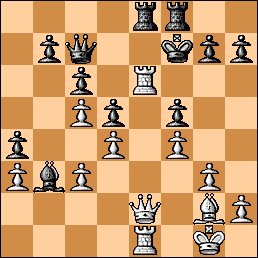
Although I had a nice win on the Sunday, it was more of a technical win with a pawn up rather than something exciting to show. Instead, I'd like to show you how I managed to miss a clear win in my recent London League game when I was playing for Hackney 1 against Drunken Knights 2. I got into time trouble again! This was partly because I was trying to remember the theory in the gambit that my opponent played and partly because I was out of practice. In any case, it seems that this game served me well as I handled my clock rather well over the 4NCL weekend. White to move.

M. Yurenok (ECF 179) - G. Leyton (ECF 167)
London League, 9th January 2012


My opponent has just moved his queen from e7 to e8 which was a mistake. He should have played Bd6 instead. At this point I still had to make 9 moves to the time control while I had maybe 1 or 2 minutes left without increment. I was in desperate time trouble but managed to find the right move:

21. Rxc7! my idea was that if black plays 21...Kxc7 then I win some material with 22. Qc2+ Kb8 23. Bd6+ Ka8 24. Bxe5 +- and there are still more threats as f6 knight is pinned and hanging. It seems I didn't notice that I can actually deliver a typical checkmate in this variation with 24. Nb6+ axb6 25. Qa4# I guess this is not too important if I'm clearly winning anyway. And in any case, black didn't have to retreat with the king on the 22nd move, but could give up the same piece differently with 22...Nc6 avoiding the checkmate. So, my opponent played:

21...Bxb5 I expected this move as I mistakenly thought it was the best reply, so I pre-planned my answer worrying that my flag might fall before I can make it to 30 moves. I immediately replied with:

22. Rxb7? =/+ this gives up all of my advantage. When you're short of time, simple and obvious moves are missed. I didn't think of moving my rook the other way, now that the bishop has left d7. The correct move was 22. Re7 At this point my computer announces +8 winning advantage for white. Oh dear :( Black can respond with 22...Bxa4 attacking my queen in return, and here the simplest for white is just 23. Rxe8 Bxd1 24. Rxh8 Rxh8 25. Rxd1 emerging with a clear piece up. My game eventually ended in a draw and my team lost 5-7. Strange that we beat the stronger Drunken Knights 1 team with 9-3 score earlier in the season!

For the past couple of days I've been following some of the Tata Steel Chess live tournament games on their website and I discovered something. They have Houdini engine giving evaluation of every move made, and it seems that even grandmasters sometimes go passed +8 advantage! Ok, not super-grandmasters but still strong players. For example, look at the GM Brandenburg - IM Grover game from round 3 in group C, which ended in a draw and where each opponent had +8 advantage at some point according to Houdini! I don't feel so bad after all :) There are lots of serious mistakes in other games too which can be fun to watch, but then anyone is clever with the help of a computer. I actually prefer listening to commentary by strong players who don't use computers, like they had in the World Cup with GM Shipov for example.

Sunday, 30 October 2011

About the British

As I said in the last post, I was going to play in the 4NCL rapidplay. I found 10min +10sec increment after each move to be closer to blitz than rapidplay and quite difficult, while the previously reported Golders Green rapidplay had 30 mins for the whole game that I preferred. I perform worst with very short time limits. Nevertheless, it was fun with the team event on the Saturday (I played for Hackney on board 4 of 4) and the individual event on the Sunday. I had some peculiar moments happen to me like not capturing a piece that I attacked with a pawn a move before (I had about 2 mins left so not really short of time!) and also accidentally grabbing the wrong piece in the opening (queen instead of bishop next to it!).

Now let me tell you about my performance at the British Championship that was held in Sheffield at the end of July/beginning of August. I qualified for it two years ago through my rating performance at the 4NCL, but as I wasn't able to play last year I carried my place over to this year. I'd never played in the British before and I really enjoyed my first time there. It's a shame it takes whole two weeks from my holiday allowance at work, so it's not something I can do every year.

Sheffield isn't quite the summer holiday destination but from chess point of view it suited me very well. In the past, I'd spent quite a lot of time in Sheffield for my work, so I knew my way around a bit. My tournament started rather badly as I lost my first two games, but I didn't get too worried as it was an 11 round tournament and I didn't think I was playing badly. In the following 5 games I got 4 points, including a win against IM Susan Lalic, a draw against my 4NCL team mate FM Laurence Webb and a draw against another strong FM David Eggleston. I got stopped by another one of my 4NCL team mates IM Adam Hunt before finishing with 1.5 in the last 3 games. So the end result of 50% and 2208 performance got me some rating points, but it would have been even better if I got another WIM norm. I had to win in either of my last two games to achieve it and was very close to it in both games, but ended up only getting 1/2 out of the last 2 games. I have qualified for the next year's British Championship through this performance, but it clashes with London 2012 Olympics in my home city!

Anyway, here are some interesting moments form my games. I was nicely surprised to hear that this puzzle from my game was published in the Daily Telegraph - the national newspaper in the UK. White to move. This one took me seconds to find, so I hope you can see it too.

M. Yurenok (2090) - S. Lalic (2277)
The British Championship, 30th July 2011


As I had plenty of time, I spent a little while checking that the move that I saw actually worked. I found no refutation, so I played:

25.Be5! the queen is overloaded so I win an exchange 25...Qxe5 26. Rxc6 Rb2? this just makes things easier for me as I can now force exchange of queens 27. Qc3 Qxc3 28. Rxc3 +- and I eventually won with the extra material.

The next diagram is from my game against a strong blind player Chris Ross. I've never played against blind players before and found it quite amazing that my opponent was playing as well as me while I can see the board and he can't. I was better for much of the game but at the end couldn't close it off. I had an immediate win in the following position, which I didn't notice possibly due to being in time-trouble. If I won this game, I would have almost certainly got a WIM norm because I would have been paired with a very strong opponent the next day making my final game result irrelevant. Can you find the white's move that I didn't?

M. Yurenok (2090) - C. Ross (2234)
The British Championship, 4th August 2011


I played 33. Bb6? losing all my advantage and the game soon ended in a draw. The correct move was:

33. Bd6! (33.Bd4 also works with the same idea) on the one hand it's a discovered attack of the white rook on the c7 knight, while on the other hand it's interference between the black queen and the rook

33...Qxd6 (33...Rxd6 34. Rxc7 +- winning the queen for a rook)

34.Rxc7+ Kg6 (34...Ke6 35. Rc6 +-winning the queen for a rook again)

35. Rxg7+ Kf5 36. Qc8+ Ke4 (36...Qe6 37. g4+ winning) 37. Rg4+ Kd5 38. Qc4 #


And finally, here is the position from my last game in the tournament. To get a WIM norm I had to win this game with black against young and progressing FM opponent from Ireland. I managed to complicate things considerably in the middlegame, which caused both of us to be in significant time trouble in the very complicated endgame with queens and bishops, below. I'm two pawns down but have sufficient compensation due to white's b2 bishop being out of play while his king's position is rather open. My king isn't particularly safe either, but I'm the first to attack, black to move.

RR. Griffiths (2301) - M. Yurenok (2090)
The British Championship, 5th August, 2011


Objectively, this position is actually a draw. I went astray and lost it in a few moves. However, if I played:

33...Qe1! this would have left my opponent with finding the only move to save his game while his seconds were ticking down. Not an easy task, especially since white's only move isn't that obvious at all. During after-game analysis both of us couldn't find an adequate reply for white until one of the observers pointed it out. Black's idea is to play Be3-f4 manoeuvre, winning if white doesn't do anything special. The only move for white to save the game is:

34.Qh1! and black has nothing better than to repeat the moves with 34...Qd2+ 35. Qg2 Qe1 =


You can check for yourself that with correct play for black none of the other moves work for white apart from 34. Qh1. There is a number of variations to consider and, of course, they are not easy to play correctly for black especially in time trouble. One example variation goes like this:


34. a4 Be3 35. h4 Bf4+ 36. Kh3 Bg6! (seemingly the only winning move) 37. Bf3 Bd3! 38. Be2 Be4 39. Bf3 Qe3! 40. Bc1 Bxf3 41. Bxe3 Bxg2+ 42. Kxg2 Bxe3 -+

Anyhow, the original position is very interesting for analysis!

Now I'm off to the European Team Championship in Greece on Wednesday. Wish me luck!

Thursday, 13 October 2011

More Results and Tactics

Lets go through a few more of my tournaments and results over the past few months. My performance at the 4NCL in 2010-11 season wasn't very good and I lost a few points of rating but my team Betsson.com at last managed to get into the Championship pool after 7 rounds in the top division. This meant that we had a theoretical possibility of winning the top division, but ended up with a much more realistic and still very good for us 5th place, which was above teams like Barbican 1 and Guildford ADC 1. The top division was won by my former team Pride & Prejudice who had GM Michael Adams on board one. 2011-12 4NCL season will start soon but during the first weekend of the tournament I will be away playing in the European Team Championship. My 4NCL team had a change of sponsor and is now called Blackthorne Russia after the name of the company which transports goods to Russia. So far I think I'm the only real Russian person registered for the team :)


In June I played in the round-robin IM-norm (not WIM!) tournament called 2nd Big Slick International, which was held at a Poker Club near London. The photo from the tournament is above, taken by my favourite chess photographer Ray Morris-Hill. As you can imagine, the tournament with two GMs in the field was quite strong for me. I lost a little rating but really enjoyed the tournament. I find it very interesting playing against stronger players. I'm sure I learnt a lot from the tournament as I did rather well in the one after that. I had a couple of interesting tactical moments in my games at Big Slick which I want to share with you.

It's black's move, what would you do? My opponent resigned but was there a better alternative? The answer is below the diagram. I was surprised to find this position published by a couple of websites like www.gingergm.com and www.chessvibes.com I guess the solution is sufficiently unusual!

M. Yurenok (2100) - S. Blackburn (1944)
2nd Big Slick International (IM), 26th June 2011


It looks like black is in deep trouble. I'm currently threatening to win the rook on e8. Black can't take on e6 because of white's Qxe6 checkmate; black can't move her rook away because of white's Re7+ winning the black queen. And if black plays Qd8 then white's Qh5+ is winning either the rook on e8 or checkmating. However, black has the unexpected:

25...Bd1! 26. Qe3 the bishop is untouchable because the rook on e6 needs protection. White also no longer has an annoying check on h5 as black bishop protects that square! White's position is still a little better because white has the better bishop, but it would take a long time to grind this one down.

Here is another interesting position but a solution is a lot simpler to see in my opinion. What move would you make for white? The solution is below the diagram.

M. Yurenok (2100) - B. Eames (2259)
2nd Big Slick International (IM), 1st July 2011


Unfortunately for me, I had only about 5 seconds left and I thought I still had to make the 40th move before the flag dropped. As it turned out, I didn't need to panic as I'd already made 40 moves and could relax and think for a few minutes if I wanted to. Nevertheless, it's probably better making one extra move than dropping the flag and finding out that you haven't made enough moves like GM Nakamura the other day at Bilbao Masters tournament. I played 41. Rxa5? Kf6! and the game ended as a draw after a few moves. There were several winning moves, but the best was:

41.Rxe3! fxe3 42. Ra8 and black can resign as he will lose the rook 42...Rxh7 43. Ra7+


In the next post I'll talk you through my performance at the British Championship in July/August, which worked out very well for me. I'd like to report my latest result to finish this post off. Last weekend I played in the Golders Green Rapidplay which was my first rapidplay in a year. I managed to do rather well and got a rating prize in the top section. I even drew with the well-known IM James Serwin. This fills me with some confidence for the forthcoming 4NCL team and individual rapidplay this weekend.

Friday, 19 November 2010

More From My Games

I played a few games in the past couple of weeks. First of all, I played at the first weekend of the 4NCL 2010-11 season (British team league). My team Betsson.com did very well as we won both matches. If we continue like this we should end up in the top half of the 1st division after 7 rounds. For the past two years we were the winners of the bottom half and felt we could do better. I did ok by drawing both of my games against similarly rated opponents, but I could have posed more problems for both of my opponents. Unfortunately, getting into the time trouble didn't help - I need to sort that out!

I also played a game for Hackney 1 team in the top division of the London League. We were outrated by our opponents Wood Green on every board (apart from the bottom borad 12 which was unrated), but somehow we managed to draw the match! Unfortunately, I lost my game against strong IM Mohamed Tissir on board 5 but not without missing some winning chances on my side. The time limit is fairly fast in the London League - 1hr 15mins for 30 moves followed by 15mins to finish and that again proved to be the deciding factor for me. With maybe a minute left on the clock I managed to miss an easy draw and a less easy win in this position - how annoying! Think about how you would have played in this position, black to move. I will provide the solution in the next post.

M. Tissir (226 ECF/2474 FIDE) - M. Yurenok (178 ECF/2071 FIDE)
Wood Green - Hackney 1
London League, 10th November 2010


There' been a lot of exciting chess going on recently with the Tal Memorial and the blitz afterwards. I'm glad that Sergey Karjakin got a share of the first prize with Levon Aronian in the main tournament. Aronian did very well to win the blitz tournament as well. I wish I had more time to watch the games - but can't do that during working hours! Currently I'm following the Russian Women's Superfinal Championship. Nadezhda Kosintseva is leading with 3.5 out of 4.

Now it's time to reveal the solution for the position published in the last post. Some of you might have noticed that the correct solution was already suggested in the comments to the last post. So here is the position again:


N. Relea (2193) - M. Yurenok (2071)
Cap d'Agde, 27th October 2010


I should have played:

52...Kh5! - it's not easy to let go of conventions and see that attacking with the king wins here even with queens and rooks present! White has two options:

53. Rg5+ Qxg5! 54. hxg5+ Rh4 55. Qxh4 Kxh4 and this pawn endgame is winning for black because white can't do anything with his extra pawn on the queenside. For example: 56. Kg2 Kxg5 57. Kg3 Kh5 58. Kh3 g5 59. Kg3 g4 60. Kg2 Kh4 61. b4 g3 62. Kg1 Kh3 63. Kh1 g2+ 64. Kg1 Kg3 65. c3 dxc3 and black checkmates in two.

or

53. Rxf4 Qxf4+ 54. Kg2 (or 54. Kg1 Qg4+) Qxh4 55. Qf3+ Qg4+ and white can't avoid exchange of queens leading again to the won pawn ending for black.

I also promised to show you an interesting double rook endgame  from another one of my games in Cap d'Agde. I know a lot of people think that endgames are boring, but double rook endgames are notoriously complex. This example is no exception, besides I think it's quite entertaining as both sides are trying to queen their pawns. Have a look at this position, black to move:


S. Pham Guerrero (2199) - M. Yurenok (2071)
Cap d'Agde, 29th October 2010


Earlier on white's endgame was quite a bit better, but he was probably trying to win too hard and allowed me to have substantial counterplay on the kingside. Here I played 42...Re3! White thought for quite a while as I guess he realised that he was now in trouble and he responded with the only move 43. b6 But even after this move black is winning. Try to find black's next move and the supporting variations leading to a win. I suggest you analyse it with the board as there are several rather complicated variations, but if you can calculate it all in your head - well done! I wasn't able to find the correct continuation and only drew the game. I hope you'll enjoy analysing this and I'll tell you what should have happened in my game in my next post.

Wednesday, 5 May 2010

Interesting Game in QGD

The 2009-10 4NCL season finished over the weekend. After 7 rounds all teams in the 1st division get re-shuffled into the "championship" pool and the "demotion" pool based on their performance up till then. My team Betsson.com did exactly the same as last year - we ended up in the "demotion" half but we won the "demotion" half again and stayed in the 1st division for the next season. Here I am in the final game of the weekend which I won. I was the last to finish in the match and my game decided our top position in the "demotion" half. The photo is courtesy of Steve Connor from the Atticus Chess Club.


I felt pretty ill at the start of the weekend but still got 2 out of 3. My performance throughout the season was 2202 earning me 31 rating points. I've also found out that this performance qualifies me for the British Championship in the summer so I'm quite happy about this achievement! I've never qualified before (at least I'm not aware if I did as rules seem to change from year to year). However, at the moment I don't plan to play in the British Championship as I will be back to work and would prefer to spend my holiday allowance on something that is not as long. Normally, British Championship results are considered by the England team selectors for either European Team Championship or the Olympiad later in that year. However, this isn't the case this year because the Olympiad is quite early in the Autumn, meaning that the England team selection has to happen before the British Championship. So this year there don't seem to be any special benefits for me playing in the British Championship as compared to any Open tournament.

As promised, here is my analysis of an interesting game I played in the Thailand Open. It was the 8th round and also my last game of the tournament since my 9th round opponent didn't turn up. You can replay the game via an applet below, but here is the game with my commentary.

Maria Yurenok (1953) - Jan E. Frantsen Montgomery (2158)
19 April 2010, Thailand Open

1. d4 Nf6 2. c4 e6 3. Nc3 d5 4. cxd5 exd5 5. Bg5 Nbd7 6. e3 c6 7. Bd3 Bd6 - this is Queen's Gambit Declined Exchange Variation (D35) but 7...Be7 is a lot more common set-up.

8. Qc2 Nf8 9. Nf3 Ng6 10. h3 - maybe a bit timid from me. There is not a lot of theory on this particular variation, but looking through my Mega Database white's more common 10th moves include Nh4, 0-0-0 and h4.

10...O-O 11. O-O h6 - I thought for a long time here as I didn't fancy any of white's moves that much, so eventually I went for what I thought was the best option even if it meant giving up a piece

12. Bxh6! - I believe the resulting position is harder to play for black. My other alternative would have been 12. Bxf6 Qxf6 13. e4 dxe4 14. Nxe4 Qd8 15. Nxd6 Qxd6 =

12. Bxh6 gxh6 13. Bxg6 fxg6 14. Qxg6+ Kh8 15. Ne5! - exclamation mark because I had to see this Ne5 idea before 12.Bxh6, otherwise white is just worse. However, 15. Qxh6 first, followed by 16. Ne5 would have been more accurate as it doesn't allow 15...Qc7 and pushes the knight to an inferior square. E.g. 15. Qxh6+  Nh7 16. Ne5 Qf6 (16... Rf6 17. Qh5 Be6 18. f4 Qe7 19. g4 [19. Ng6+? Rxg6 20. Qxg6 Bxh3 -/+] Rg8 20. Kh2 - unclear) 17. Qxf6+ Rxf6 18. f4 +/=

15... Bxe5?! - it was better to play 15... Qc7 16. Qxh6+ Kg8 17. f4 Qg7 18. Qxg7+ Kxg7 19. g4 - unclear

16. Qxh6+ Nh7 17. dxe5 Qg5? - black should have kept the queens as otherwise my pawns are too strong. With the queens still on black's counterplay is around forcing white to play f4 and attacking b2 and e3 pawns with Qb6 which results in a very unclear position, e.g. 17... Qc7 18. f4 Qb6 19. Rae1 (19. Nd1 feels a bit passive though possible) Qxb2 20. Ne2 Rg8 (20...Qxa2 21. g4 - unclear) 21. g4 Bxg4 22. hxg4 Rxg4+ 23. Kf2 Rag8 24. Rh1 Rg2+ 25. Kf1 Qc2 - unclear

18. Qxg5 +/= Nxg5 19. f4 Ne4? - it's not a good idea for black to exchange knights because it cuts out any counterplay based on d4 push and instead black's e4 pawn would end up on the same colour as his bishop. Better move was 19... Nf7 20. g4 +/=

20. g4 - I failed to realise that the immediate knights exchange with 20. Nxe4 was a better move for me, e.g. 20...dxe4 21. g4 +/-

20...Nd2 21. Rf2 Nc4 22. Re1 Nxe3 - it was a bit better for black to keep the knight with 22... Re8  23. b3 Nb6 24. Rd1 +/-

23. Rxe3 d4 24. Rd3 dxc3 25. bxc3 +/- since exchanging the queens, black spent five moves with his knight instead of improving position of his pieces while I put most of my pieces into active positions.

25...Be6 26. f5 Bd5 27. e6 - it was more accurate for me to improve the position of the last piece - the king - as black has no counterplay, e.g. 27. Kh2 Rae8 28. Re3 b5 29. Kg3 a5 30. Kf4 +-

27...Rae8 28. Rd4 b5 29. g5 a5 30. h4 a4?! - at this point the best practical chance for black to make a draw would have been 30... Bxa2 31. Rxa2 Rxf5 32. Rxa5 Rxe6 33. Ra7 Re8 34. Kg2 +-

31. a3 Bxe6?! - black's cracked and given back the piece but it's hard to suggest much else as otherwise white's pawns go forward anyway. Here is an example variation: 31... Re7 32. h5 Kg8 33. h6 Ree8 34. Rff4 Kh7 35. Kf2 Rg8 36. Rg4 Ref8 37. Rdf4 Rxf5 (otherwise white's king comes forward decisively) 38. Rxf5 Bxe6 39. Rgf4 Bxf5 40. Rxf5 Kg6 41. Rc5 +-

32. fxe6 Rxf2 33. Kxf2 Rxe6 34. Kf3 Re1 35. Kf4 Rc1 36. Kf5 Kg7 37. h5? - a moment of madness from me as I started seeing ghosts. Of course, 37. Rd7 was winning straight away which for some bizarre reason I discarded. E.g. 37. Rd7+ Kf8 38. h5 Ke8 39. Rb7 and white's pawns can't be stopped. My move would have made winning a lot more difficult for me if black replied correctly. But it must have been my lucky day (you need luck sometimes even in chess!) as my opponent replied with his own mistake:

37... Rxc3? - instead black should have played 37... Rf1+ posing some technical problems for me as I was approaching time-trouble e.g. 38. Kg4 (38. Rf4? only leads to a draw after 38...Rxf4+ 39. Kxf4 c5 =) 38... Rg1+ 39. Kf4 Rf1+ 40. Ke3 Re1+ 41. Kf2 Rh1 42. Rd7+ Kh8 43. Rd8+ Kg7 44. h6+ Kg6 45. Rg8+ Kh7 46. Rg7+ Kh8 47. Re7 c5 48. Kg3 b4 49. cxb4 cxb4 50. axb4 a3 51. Ra7 Ra1 52. Kg2 threatening 53. g6 +-

38. h6+ Kf8 39. h7 Rh3 40. Kf6 Rf3+ 41. Kg6 Rh3 42. Rd8+ Ke7 43. h8=Q Rxh8 44. Rxh8 1:0 
It may not have been the perfect game but it was a bit entertaining and even GM Nigel Short liked watching it!

Sunday, 11 April 2010

A bit about Grunfeld

Time flies when you're having fun! I've had some nice things happen in my life in the past few weeks but not anything to do with chess. That somewhat slack attitude might come back and bite me as I'm off to Bangkok tomorrow to play in Thailand Open and feeling like I could have done more to prepare. But I'm not sorry about it - it's important to be happy in life and not just in chess. Thailand might prove to be more "exciting" than I expected. There is currently some political unrest going on with demonstrations that could potentially bring down the current government. To be fair, I've already seen Bangkok and don't need to get out of the hotel if the troubles continue. My real holiday will be for a few days after the tournament on the Thai island of Koh Chang - away from any revolutions. It will be interesting to see if any chess players decide to pull out of the tournament because of unrest but for now the top seed promises to be England's own GM Nigel Short.

Ok, I haven't been ignoring chess completely. I've had a look at some games of the former world champion GM Vasily Smyslov who sadly passed away a few days ago. His games seem so smooth - almost effortless. He was well known for trying to search for the ultimate "truth" and harmony when playing chess. I've also continued my training sessions with GM Chris Ward and I've played a few serious games of chess in the London League and the 4NCL. The last game in the London League was completely disastrous for me as I managed to lose a completely winning position. Not only my position was better, I was also and exchange up!   Perhaps a large dinner before the game didn't help very much as I found it difficult to think and make any decisions when I was confronted with some options. I did much better at the 4NCL gaining 1.5 out of 2 against stronger opposition.

I'd like to show you the game I won from that 4NCL weekend. It was my first serious game against Grunfeld Defence and I was well prepared. Quite fittingly, I chose to play the Russian System against Grunfeld (D36), maybe because I quite liked GM Magnus Carlsen's recent wins in that opening against GM Svidler and GM Dominguez. You can replay the game via an applet below but here is the game with my commentary.


M. Yurenok (1953) - S. Hegarty (2067)
27 March 2010, 4NCL

1. d4 Nf6 2. c4 g6 3. Nc3 d5 4. Nf3 Bg7 5. Qb3 dxc4 6. Qxc4 O-O 7. e4 c6 - I expected this. 7...c6 is described by GM Rowson in his Grunfeld book as the most passive option for black. After looking through some GM games on the database I can't say I disagree as I liked white every time. No wonder GMs Svidler and Dominguez choose to play 7...a6.

8. Qb3 Qb6 9. Bc4 Qxb3 10. Bxb3 - my preparation ended here. It's quite easy to find decent moves for white in this position while black has to do all the thinking to create counter-play. I was 40 minutes ahead on the clock at some point and finished 20 minutes ahead while my opponent got into time-trouble. It's not easy to develop black's pieces.

10... Bg4 11. Bg5 - it was worth considering 11.Ne5 because if the black bishop doesn't move I'd still get the bishop pair without doubling of my f pawns and if 11...Be6 12.Bxe6 I'd ruin black's pawn structure. However, the move that I made is also fine and threatens 11...e5 winning e7 pawn.

11... h6 12. Bf4 - Rybka doesn't quite understand that move and really wants to put the bishop on e3 but I believe the bishop on f4 is more active

12... Bxf3 - expected natural follow-up to 10... Bg4 but 10... Nbd7 was also possible

13. gxf3 Nh5?! - it's not clear what this achieves as 14... e5 isn't possible and d4 pawn is easily defended

14. Be3 Kh7 15. f4 - black pieces are still cramped and white has a nice centre

15... Nf6 16. h3 - not really necessary as losing e3 bishop for black's knight is not really a threat, so 16.e5 is a good alternative

16. h3 e6 17. O-O - another option is to castle queenside and play for an attack with f5 and Rhg1

17... Nbd7 18. e5 - I thought for a while about this move as it gives up d5 square but decided that my knight on d6 would be better than black's knight on d5. However, it was probably better to develop rooks first before fixing the pawns in the centre.

18... Nd5 19. Ne4 f6?! - this doesn't stop me from doing what I want. The better plan was to put pieces like that: Rab8, N7b6 via c8 to e7 and then to f5.

20. Nd6 fxe5 21. fxe5 Rab8 22. Bxd5 - I had to think a little here as it appears that I'm giving up my "good" bishop but I'm giving it up for the only black's active piece and neither of black's re-captures seems attractive

22... cxd5? - this was the worst of the two evils as now I can't see how black can avoid losing some material. After 22...exd5 I was planning 23. e6 Nf6 24. e7 Rg8 but I couldn't see what to do next and Rybka confirms that this doesn't achieve much for white. Instead, 23. f4 would have been a simple way to maintain an advantage. f5 may become a threat at some point, Rac1, b4 and b5 with minority attack is another threat.

23. Rac1 Rfd8 - it's hard to suggest anything better for black anyway, the rest is straightforward

24. Rc7 Nf8 25. Rfc1 a6 26. Rxb7 Rxb7 27. Nxb7 Rd7 28. Nc5 Ra7 29. Rc3 Kg8 30. Ra3 Kf7 31. Rxa6 Rc7 32. b4 Re7 33. Rd6 1:0

Tuesday, 9 March 2010

Reykjavik Tournament

I'm finally back in England and glad to be back! I enjoyed Iceland - it's definitely worth seeing, though it might be a bit more enjoyable in the summer as it wouldn't be so cold. After the tournament finished Simon and I hired a car for a couple of days and saw some amazing scenery, hot geysers and the Blue Lagoon. Just look at this waterfall called Skogafoss!


The Blue Lagoon is an open-air swimming pool with unnaturally light blue water because of all the minerals. While your head is in the open air of about 0 degrees Celsius with nasty wind blowing from every direction, the water is a very pleasant 38 degrees Celsius. We spent about 2 hours in there and it was very relaxing. Here is another waterfall called Gullfoss - do you think I look a bit cold?? Not only it was cold, there were a lot of cold water droplets blowing from the waterfall.


So how about chess? I didn't do very well again. I got my usual 3.5 out of 9 and lost lots of rating again - about 13 points. Here is the official tournament site if you'd like to have a look: Reykjavik Open. I found this tournament pretty hard going maybe because I've overdone on chess a bit lately. Since I played at Uxbridge and at the 4NCL it means I had almost no breaks from playing chess since 13th February. I don't know how professionals do it, perhaps I need to get fitter physically! It's very hard mentally as well if you don't get the results you think you should. Bearing all that in mind, I've decided to have a break from tournaments for a month and train instead. My next tournament will be in Thailand in April and until then I'd just be playing occasional league games. I didn't even have any interesting games worth showing, so instead I'll dig into my games archive from the past few months and show you something interesting from there in the coming posts. I was also a bit disappointed that no one played the King's Indian or Nimzo-Indian against me! I really need to practice those openings. Anyway, here I am at the Reykjavik tournament.


The tournament itself was very well organised and the venue was very pleasant. We even went to the chess quiz and blitz in the evenings. Our team of four English players did pretty well at the quiz despite being half an hour late! And the blitz - well, don't mention the blitz! I'm terrible at it so I'll see you on the ICC and Playchess trying to improve!

This week should be pretty good as it will be my birthday and I have a couple of celebrations planned with my friends. I also have a sweet tooth so very looking forward to yummy desserts and cakes!

Tuesday, 23 February 2010

Uxbridge All-Play-All

Hello everyone! It's been a busy few days for me. I finished playing at Uxbridge on the 17th February, then played at the 4NCL over the weekend and now I'm in Reykjavik, Iceland - ready to start another tournament tomorrow! Here I am playing my second game at Uxbridge, photo taken by the organiser Sean Hewitt.

Maria Yurenok

I had a disastrous start to my tournament in Uxbridge - I lost 4 games in the row! I was feeling very down at that point. However I managed to follow that up with 3 wins, one of which was against the overall tournament winner Mark Josse. I outplayed him in the endgame and was the only one who beat him. Disappointingly, I lost the final game against the chess player who got the second place even though I was two pawns up at some point. You can see the final tournament table here. The strange thing is I felt as if I'm definitely playing better chess than a few months ago but I seemed to be smudging my finishes in most games that I lost. Another interesting thing is I seem to be playing more aggressive chess which is quite entertaining and complicated at the same time. Sadly I still keep losing rating points - another 10 this time. Of course, there's not much point worrying about rating right now - I just need to improve my chess.

I did much better at the 4NCL. I got 1.5 out of 2 including a win against 2115 FIDE in the nice style. Time limit at the 4NCL was much longer than at Uxbridge, so I guess I had enough time to find a way to covert my advantage. Here I am at the start of the game that I won at the 4NCL. I look quite mean - I was indeed playing for a win!

Maria Yurenok

Unfortunately, my team Betsson.com lost that match 3.5:4.5. It was a very important match for us. Even though we won the second match of the weekend it will now be very difficult for us to get into the top half of the draw. In the next round (held towards the end of March) we have to win 5.5:2.5 against the strong team Wood Green Hilsmark Kingfisher 2 in order to get into the top half. It may turn out to be a very interesting encounter because if we win then our opponents will not get into the top half, so everything will be at stake for both teams.

The weather in Reykjavik is not much colder than in London, but the wind makes it 10 times worse! Even though it was sunny today, I was freezing only after a few minutes outside and had to hop into several shops and coffee bars to keep myself warm while walking around. Here is an unusual church in the centre of Reykjavik.

Reykjavik

But the birds don't seem to mind the wind and the mostly frozen lake. This is near the playing venue - City Hall.

Reykjavik

I still haven't got the draw for the first round but you'll be able to find it here together with the tournament results. I'll give you my update in a few days.

Friday, 5 February 2010

Barnet Congress

I enjoyed playing in Barnet Congress last weekend. I got 2 out of 4, but performed above my rating. The only game that I lost was to Jovica Radovanovic who is graded quite a lot above me at 218 ECF (his FIDE is 2337). The game was very entertaining. Playing Sicilian as black, I grabbed a pawn for white's compensation. Later on I had to give up an exchange but white opted to give it back straight away. Following that I decided to give up two pawns to transpose into what looked like a drawn endgame. Unfortunately, I wasn't able to draw 2 vs. 3 pawns on the kingside and rook each. I was ground down and actually lost on time at the end. As I found out it's not at all easy to defend this ending under the time pressure even though many people would think of that position as an easy draw! That's certainly a game that needs thorough analysis.

The tournament was won by three people, among them my Hackney team captain - Bob Eames, so congratulations to him. I also had a nice win in 21 moves. Have a look at the diagram, I'm a pawn up but still a fair bit away from winning. However, black helped me to secure an immediate win by moving Re8-f8. What's wrong with that move and how white should reply?

M. Yurenok (173) - M. Peat (179)
30th January 2010, Barnet


On Monday I played a game for the first Hackney team in the London League. I drew against my 4NCL team captain Steve Ledger who was playing for Streatham! But it wasn't a "grandmaster" draw, we were fighting until the end. I played with white against Benko Gambit for the first time and got a good position but didn't manage to make anything out of it. In time trouble I lost a pawn but Steve made an inaccurate move that allowed me to transpose into a drawn R+P endgame. My team, however, lost as we were outrated.

And here is the solution to the last post's puzzle (G. More - M. Yurenok). Thanks to those who sent the answers, now you can compare your thoughts with mine during the game. The game continued: 

23... Bxg3 24. hxg Bxe4! Now white can't take 25.Bxe4 because of deadly 25...Ne2+ check winning the queen, and taking 25. Bxd4 instead doesn't help either as after black's 25...exd4 attacks the queen leaving me a piece up as bishop on g3 will escape re-capture.

After 24...Bxe4 white is not just a pawn down, but her position is totally disintegrating due to too many threats. Rook on b1 is under attack but has nowhere to go. If it moves from b file - pawn on b3 falls to 25...Rxb3. If b1 rook stays on b file, e.g. 25.Rb2 then black wins a rook by 25...Nxf3+ and 26...Rxd1. On top of all of these there are still threats of black taking on f3 with the bishop and winning the queen by Ne2+. The game continued:

25. Rbc1 Rxb3 26.Qxb3 (26. Bxd4 Rxc3 27. Bxc3 was a bit better but still losing) Nxb3 27. Rxd8+ Qxd8 28. Rd1 Nd4 29. Kf2 Bxf3 30. gxf3 Qf6 31. f4 exf4 32. gxf4 e5 33. Rb1 h6 34. Rb8+ Kh7 35. Kg3 exf4+ 0:1

Wednesday, 20 January 2010

Thoughts about Openings

Since I came back from Hastings I haven't done much chess because of some health problems, but I'm now nearly back to normal. Over the weekend I played two games in the British team league 4NCL and got 1.5 points. I was happy with a quick draw against a stronger opponent on Saturday and managed to win against a weaker opponent on Sunday despite feeling very unwell, so it was a good result. My team Betsson.com lost one match and won one. The next 4NCL weekend is in a month's time and my team needs to try winning both matches because later in the year the two pools in our top division get re-arranged into different two pools according to teams' performance. Last year we were the winners of the bottom pool, so this year we need to do better and get into the top pool instead.

I've had some interesting e-mails from readers of my blog, thank you very much for those. I do enjoy reading your own stories about chess and happy to answer your questions. So please keep e-mailing me at myurenok@btinternet.com and let me know if there are any particular chess topics you'd like me to cover in my blog.

I was recently asked how I develop my openings repertoire. Some of it evolved over the years and some of it was more intentional. For example, against 1.e4 my dad taught me the Taimanov Sicilian many years ago and I still play and love it as an opening. Against 1.d4 my dad taught me the Benko Gambit. Even though I still like that opening I decided to learn something more solid once I re-started playing chess after the university, so I chose to learn the Slav towards the end of the nineties. In hindsight, it was a very good decision as this opening suits me very well. Besides, my coach IM Simon Ansell plays it too and I can learn a lot from him! Another advantage of the Slav is that against 1.c4 I can play 1...c6 and after that white often chooses to transpose into the Slav anyway. I've also recently learned the Dutch Stonewall which is a handy alternative to the Slav not requiring a lot of theory knowledge. Besides, I can also apply it with reversed colours as white. At some point soon I'd also like to learn an alternative opening against 1.e4. I already decided what it should be but will keep it a secret for now.

Strangely enough I had a lot more problems with my white openings. I used to play 1.e4 as a junior, but after several years absence from chess my dad suggested that I play something that doesn't require a lot of theory knowledge - The Torre Attack. And that's what I played since I finished the university. I got really fed up playing it for so long (about 10 years!) since it's not as varied as main lines and I wasn't happy with my white results either. Now I have started playing main lines 1.d4 and very happy with the variety of interesting positions that I get out of it. Playing the Torre Attack earlier helped me with understanding some of the main line 1.d4 structures, so it's not all totally new to me. I've also found a new coach who can specifically help me with 1.d4 main lines for white and if all goes well the training will start next week.

Of course, I consider other things when choosing opening lines. For example, even main line 1.d4 has many options for white to choose from. I tend to choose those lines that are most suitable to my style, so that I feel comfortable with resulting positions. And if I'm preparing for a specific opponent I sometimes learn something totally new either to surprise or to avoid something. If my memory was a bit better I would happily play a large variety of openings because I would enjoy new types of positions and plans. I may do that sometime in the future anyway, just for fun. But for now I have a specific aim to get my rating up as soon as possible and for that I think I need to learn a limited number of openings very well. The basic idea behind a limited openings repertoire is to get a familiar position with a familiar plan to preserve the time early on, so that there is time available for complicated decisions and calculations in a critical moment later in the middlegame.

Thursday, 5 November 2009

The London League

Yesterday I won my game for Hackney in the London League against an opponent of the same ECF rating as me. It was especially nice to win because I was on the white side of Benoni for the first time in my life, without any preparation. Basically, I'm fed up with boredom playing the Torre Attack or other similar non-main lines with white. I've only been playing those because I haven't been spending any time on learning chess in the past 6 or 7 years. Now that I'm being serious about chess - it's time to play more ambitious main lines! So, my coach Simon Ansell told me just to play d4 and c4 and not to worry about not knowing the theory. It turned out to be a very good advice as I managed to figure out the first 12 moves of theory anyway at which point my opponent deviated from the theory by making an inferior move and made a losing mistake the move after. Maybe my memory isn't as bad as I think if I remember how to play Benoni without ever learning it. Unfortunately, my team lost but I'm sure we'll win next time.

What really puzzles me about the London League is why it is still possible to adjourn the games. Chess has speeded up and we need to keep up with the current trends to allow our players to get used to the faster time limits to be more competitive in the wider world. Probably only in England we still use adjournments while the rest of the world has got rid of that rule a long time ago. Perhaps I should start a campaign to abolish adjournments in the London and other English Leagues! While I'm on the subject of time limits for a game, I also think that 4NCL games should be speeded up to at least 2hr for 40 moves + 1 hour to the end, abolishing additional 30 minutes. And if 4NCL could obtain enough electronic chess clocks, then we should move to the incremented time limit like most international tournaments.

Bob did bring me whole 4 books about the "mystery" opening that I'm going to learn. Simon's advice is the same - just play it and learn from books afterwards... That may not be very scary with white, but with black there is more chance of getting into serious trouble! So, perhaps I'd test it out on the ICC and in the rapid plays before using in a long play game.

I'm currently making plans for my future tournaments. My next tournament would be the women's invitational alongside the London Chess Classic in December, and at the end of December I'm off to Hastings. Beyond that I'm struggling to make my choice as I have several options. I could go either to Gibraltar or to Moscow. There is the Moscow Open starting at the end of January which is directly followed by the Aeroflot Open. It's a rather good deal because I'd have two tournaments and would fly to Moscow only once. But I haven't experienced Russian winter for 16 years and might not enjoy the cold weather... The other dilemma is whether I shouldn't be playing so much chess and should be training instead. I think I'll see how my November training is coming along before deciding what to do about February.

Friday, 23 October 2009

Chigorin Memorial Tournament Part 2

It's nearly the end of the tournament. I've got 2 out of 7 so far with 2 games to go. GM Volkov is the sole leader in the tournament with 6 points. I'm not looking forward to Saturday because the game will start at noon as compared to 5pm on all other days. That will be a bit of a shock to the system since I'd have to get up early to prepare. Most chess players seem to be night owls. Even a lot of very strong players like grandmasters stay up until late and get up in the afternoon! Here is the promised photo of me playing in the 4th round.

Maria Yurenok
I've been out in the centre of St. Petersburg twice and really enjoyed it. It's nice to get out of the hotel into the fresh air. I've walked along Nevsky Prospekt to the Winter Palace and then around Kazansky Sobor and Isaakievsky Sobor (Cathedrals). Isaakievsky Sobor is especially beautiful inside and definitely worth the visit for anyone coming to St. Petersburg. And from outside it looks like this:
Isaakievsky Sobor
The European Team Championship has started yesterday. I wish good luck to all the men and women representing England! The women's team is represented by: IM Jovanka Houska, WIM Ingrid Lauterbach, WIM Natasha Regan, WFM Meri Grigoryan and WFM Sabrina Chevannes. I'd just missed out on the selection into the team, which is just as well since I need to get better at chess first! The British team league 4NCL is starting tomorrow and I wish best of luck to my team Betsson.com! I won't be participating in the first two rounds since I'll be still in St. Petersburg.

Finally, I'd like to bring your attention to GM Alexandra Kosteniuk's chess blog. In case you don't know - she's the current Women's World Champion and a great role model for women's chess. I check her blog every time I go on internet as it's updated frequently and provides a lot of interesting material to read. It ranges from chess analysis and puzzles, to chess news and discussion of important issues in chess. I especially recommend that you read her post from 17th October called "Abolish Women's Titles? Ridiculous!" I totally agree with her on this issue.

Sunday, 27 September 2009

My Chess Autobiography

Thank you very much to everyone who reads my blog. I've had hits from all over the world, which is much more than I expected when I started this. I hope you'll find this blog interesting and worth reading in the months to come. Some of you may not have met me or just don't know much about me, so it's time to give you a bit of chess background about myself.

Chelyabinsk
I was born in Chelyabinsk in Russia what seems like a very long time ago. Chelyabinsk is a large town of over 1 million people and it's a capital of Chelyabinsk region and of the South Urals. Until recently, the most famous GM to emerge from there was Sveshnikov because of Sveshnikov Sicilian. Strangely enough I was in the same class with his daughter at school.

My dad taught me chess when I was very little. I remember learning checkmate with two rooks when I was about 5! When I was almost 7 I started going to a Chess School. The Chess School was somewhere children could go after traditional school finished for the day and I went there about twice a week. Chess has always been considered a sport in Russia, so like many other sports it was heavily subsidised during communist times, which meant I had plenty of opportunity to travel to tournaments and train with good coaches for free. We even had free full medical check-ups twice a year!

Since I was a promising junior, I was also invited to attend the Chess School of GM Panchenko which happened twice a year. That's what people call "the Russian Chess School"! Juniors from all over Russia had very intense training for a couple of weeks, which included lectures from IMs and GMs, tests and some practical chess. It was completely invaluable experience - I should have paid more attention at those lectures, as that school produced many GMs! You can read more about Panchenko School here if you can read Russian: http://www.e3e5.com/article.php?id=1458 You may even recognise mini-me in a couple of photos :)

I was the best girl junior not only in Chelyabinsk region, but in the wider zone of Russia that included neighbouring regions. My best achievement at the time was 2nd place in the Russian girls' championship under 18. The local government of Chelyabinsk even awarded me a scholarship for this aceheivment. I did fairly well in the Russian Women's cup too. The other memorable achievement was that my school team won the schools' championship of Russia called "The White Rook". We did very well in the Soviet Union championship too - we got a second place once. The team consisted of 4 boys and 1 girl (me).

After I finished traditional school at 17, I went to study in Plymouth in the UK. I played a bit of chess for a year and went to the local chess club, but for the following 4 years I gave up chess altogether. Being a student, I found it difficult to find money and time for travelling. Since I was one of the strongest players in the Plymouth chess club, I got bored of going there too. After I gained my BSc in Business Information Management Systems, I got a job and with it the money. More importantly, I got back the will to train myself and play chess again. I also relocated to Berkshire where chess tournaments were far more accessible compared with remote Devon. A few years later I got my FIDE rating and WFM title. Around that time I also played for the Guildford ADC team in the top division of 4NCL British Chess league and we won the league.

My dad Sergey YurenokAfter that I pretty much stopped training and played mainly in the 4NCL for a number of years. My personal life took over and kept me busy until now. But lack of training meant that I consistently performed below my rating and at the end I lost more than a 100 rating points over few years. Now I'm getting my rating back and aiming to get even more than before. My aim is to get to the WIM performance level in the coming months. The other aim is to become better than my dad!! Papa, I hope you are reading :) My dad is a strong Candidate Master and coached me a lot during my many years of playing chess. Now that he's moved to live in the U.S.A., he's got his FIDE rating too. It's 2254 and he's aiming to become a FIDE Master. Bring it on!

Friday, 11 September 2009

Cats and Birds

It's the start of the new chess season for team competitions and I'm looking forward to catching up with friends, some of whom I haven't seen since the spring. I'm also looking forward to one of the great 4NCL traditions followed by many teams - Indian curry dinners! 4NCL is the British team league in case you don't know. I currently play for two teams: for Hackney in the top London league and for Betsson.com in the top division of 4NCL. I've also been recently invited to play in the Surrey Border and Berkshire Leagues for Sandhurst CC, but won't be able to make their September matches. I wonder if I'm taking on too much!

It's still 2.5 weeks to go before the start of my sabbatical and currently I mostly work from home. Earlier this week my work was briefly disturbed by a noisy commotion in my garden. I came outside to find that my 8.5 year old slightly overweight cat somehow managed to catch a pigeon! There were feathers flying everywhere. Not quite sure how I managed to rescue the poor pigeon and lock my cat inside. But then I became very worried that the pigeon won't be able to fly again as he kept pacing around the garden not flying anywhere. He also ignored the bread I tried to feed him. He must have been in a state of shock, but after about 10 minutes he took off. He was lucky, as I'd already found a small dead bird in my conservatory earlier in the summer...

My cat is a girl called Koozya. Russian speakers among you would be a bit surprised about this because Koozya is a male name, but I liked it! She's definitely become a bit more active since I've put her on the diet a few months ago, even though her age is now equivalent to 50 human years! She's on the diet because I don't want her to get diabetes or other serious health conditions. Here she is - my gorgeous, loving cat with murderous tendencies:

Koozya
She's very good at chess too - she just throws pieces off the table early in the morning to wake me up, so that I feed her. She's a bit obsessed with food, so no wonder she's trying to supplement her dinners from outside. I know what's going to be next on her menu - she's been eyeing up the local grey squirrel for quite a while. I'd rather she kills off all spiders in the flat.

And finally, I'm playing in the Golders Green rapidplay tomorrow. I don't even have a rapidplay rating because I haven't been playing in these kind of tournaments for ages. I'll let you know how I get on in a couple of days.